
Projects start slipping when responsibilities blur, tasks scatter across tools, and teams push ahead without a structure that supports clarity. The urgency is real, with about 78,200 job openings projected for project management specialists per year from 2024–2034, driven largely by workers shifting careers or leaving the labor force, which increases the pressure on teams already stretched thin. A well-defined project management organizational structure helps steady that pressure by giving teams clear ownership and smoother coordination. Understanding these structures equips you to organize workloads effectively, reduce friction, and build a workflow that supports focus instead of constant firefighting.
Key Takeaways
Project management organizational structure determines who makes decisions, how teams communicate, and how tasks move from planning to delivery.
Clear structures reduce overlapping responsibilities, prevent approval delays, and create predictable workflows that support focused, efficient project execution.
Functional, projectized, matrix, hybrid, team-based, and network-based models each offer a different balance of authority, specialization, collaboration, and resource flexibility.
Choosing the right structure depends on project volume, team expertise, decision speed, cross-functional requirements, and whether work happens in a co-located, hybrid, or distributed setup.
What is a Project Management Organizational Structure?
A project management organizational structure defines how responsibilities, authority, and communication flow within a team, shaping the way work gets planned and delivered. It acts as the foundation of every project, outlining who makes decisions, who handles execution, and how resources move across tasks. When this structure is unclear, teams face overlapping duties, stalled approvals, and recurring bottlenecks that drain productivity. A clear structure, on the other hand, gives you predictable workflows, smoother collaboration, and the stability needed to manage priorities without constant disruption.
With the foundation in place, it becomes easier to see the practical benefits that come from choosing a structure that supports the way your team works.
Key Benefits of a Project Management Organizational Structure
A defined project management organizational structure helps you work with more confidence, clearer priorities, and fewer interruptions as projects move forward.
Here are the benefits that genuinely improve how you manage work and coordinate with your team:
Clear role boundaries give you a solid understanding of what you own and what others are responsible for.
Established communication routes help you reach the right person faster and avoid unnecessary back-and-forth.
Predictable workflows make it easier for you to stay organized, maintain momentum, and prevent tasks from slipping.
Well-aligned goals and resources allow you to plan your time, energy, and team capacity with less friction.
Stronger accountability helps you avoid duplicated work and identify delays before they affect the entire project.
Clear authority levels support smoother decision-making, especially when projects need timely approvals.
Reliable access to the right people and tools helps you plan more realistically, even when multiple projects run at once.
Defined responsibilities protect deep-work time, making it easier for you to stay focused during demanding phases of a project.
Balanced workload distribution prevents burnout and supports healthier project pacing across the team.
Structured prioritization helps you manage competing deadlines without feeling overwhelmed or stretched thin.
A stable framework strengthens cross-functional collaboration and reduces the friction that usually comes from working in silos.
Also read: Goal-Setting Frameworks Every Professional Should Know
Once that influence is clear, the next step is to understand the structure options available and how each one shapes your approach to managing projects.
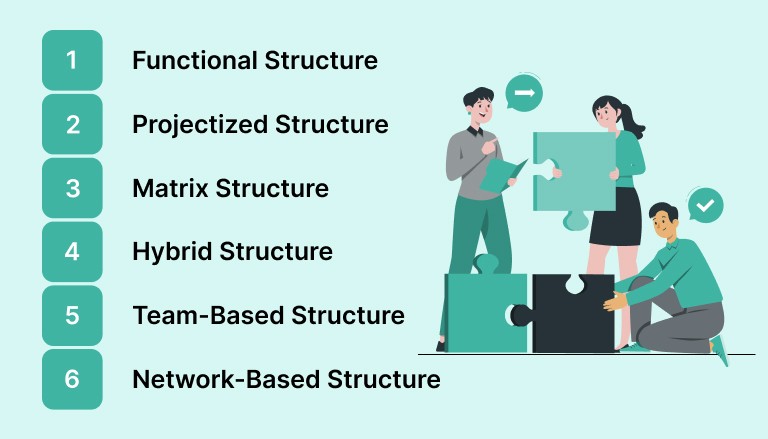
6 Types of Project Management Organizational Structures
Six major project management organizational structures influence how you plan work, share information, assign responsibilities, and keep projects moving.
Here is a clear explanation of each structure so you can compare them and determine which one fits your team’s workflow.
Functional Structure
A functional structure organizes teams by departments such as engineering, design, finance, or marketing. This setup gives you deep subject-matter expertise because everyone works within their specialized skill area. Progress can slow when cross-department collaboration is required, which makes it harder to respond quickly to changing project needs.
When to use it:
When projects slow down because tasks require deep technical work that generalists cannot complete accurately.
When different teams produce inconsistent results because each group follows its own standards or methods.
How it helps:
Keeping specialists inside their department ensures the work is handled by people with the right training, which raises quality and reduces errors.
Standardized processes within each department create uniform expectations, so projects follow the same guidelines instead of varying from team to team.
Projectized Structure
A projectized structure builds dedicated teams around individual projects, and the project manager holds strong authority over decisions, resources, and timelines. This structure gives you faster execution because everyone works toward a single project goal without competing priorities. The challenge appears when staffing becomes stretched, especially if multiple projects need their own fully dedicated teams.
When to use it:
When projects fall behind because people are splitting attention between multiple responsibilities.
When decisions stall because no single person has clear authority over timelines, resources, or direction.
How it helps:
A dedicated project team works toward one goal, which eliminates context switching and keeps progress steady.
Clear authority lets issues get resolved quickly because the project manager controls staffing, priorities, and decision-making.
Matrix Structure
A matrix structure blends functional and projectized models, allowing team members to report to both a department lead and a project manager. This setup gives you more flexibility in sharing talent across projects while still keeping people connected to their expertise areas. Confusion can arise if expectations are not clearly communicated, which makes role clarity essential for this model to work.
When to use it:
When projects stall because only one team has the needed expertise, it creates bottlenecks and long wait times.
When certain teams are overloaded while others have capacity, it creates an uneven workload.
How it helps:
Shared resources give projects access to the right experts at the right time, reducing delays.
Workload can be balanced across teams more effectively because functional leads and project managers coordinate assignments together.
Hybrid Structure
A hybrid structure combines elements from functional, matrix, and projectized models to match a company’s unique workflow. This structure helps you adapt to changing priorities because it allows a mix of stable roles and project-focused collaboration. The approach requires strong coordination to prevent overlap, especially when multiple structures operate at the same time.
When to use it:
When some projects need strict oversight, while others require fast-moving or experimental workflows.
When the team struggles because one structure feels too rigid for certain projects, but too loose for others.
How it helps:
Each project can operate under the model that fits its goals, which keeps workflows smooth instead of forcing everything into one system.
Teams get flexibility without losing the stability of their core department processes.
Team-Based Structure
A team-based structure groups people into small, cross-functional units that own broader outcomes instead of isolated tasks. This model helps you move faster because teams can collaborate without waiting for multiple layers of approval. The challenge comes from keeping teams aligned, particularly when several units must coordinate to deliver one larger project.
When to use it:
When projects slow down due to long approval chains or frequent handoffs between departments.
When teams lose momentum because important decisions sit with people far from the work.
How it helps:
Cross-functional teams make decisions closer to the work, which shortens response times and keeps progress moving.
Collaboration improves because everyone contributing to the project operates within the same unit.
Network-Based Structure
A network-based structure relies on distributed teams, contractors, partners, or remote specialists connected through digital workflows. This approach gives you the flexibility to scale quickly and bring in talent from anywhere. Success depends on having reliable systems, clear communication, and strong visibility into tasks so that work stays coordinated across locations.
When to use it:
When projects require niche or temporary skills that aren’t available inside the team.
When globally distributed contributors struggle to stay aligned due to time zones or inconsistent communication.
How it helps:
External and remote specialists can join projects as needed, giving teams access to skills without long-term hiring.
Clear digital workflows keep everyone aligned, even when contributors work in different places or schedules.
Also read: Simple Productivity Planner to Achieve Goals
Knowing the differences between these structures makes decision-making easier, so the next section focuses on the features of the organizational structures.
Features of an Organization Structure
An organizational structure is shaped by several features that influence how you communicate, make decisions, and coordinate work across a project.
To understand how these elements guide the way you operate, here are the core features explained clearly:
Authority Layers: Shows who holds decision-making power so you know where approvals come from and whom to approach when issues arise.
Example: When a timeline shifts, knowing exactly which lead signs off on changes keeps work moving instead of stalling.
Work Distribution: Defines how tasks are assigned across strategic, technical, and support roles, helping you focus on the work that matches your expertise.
Example: A designer handles visual assets while a strategist plans messaging, preventing both from stepping on each other’s responsibilities.
Manager-to-Team Ratios: Explains how many people a leader supervises, which affects how closely your work is supported and how quickly concerns get addressed.
Example: Smaller teams get quicker feedback, while larger teams require clearer systems to keep everyone on track.
Role Categories: Distinguishes between roles that handle core project tasks and roles that assist or advise, giving you visibility into how your contribution fits the bigger picture.
Example: A QA tester contributes directly to product quality, while a training specialist supports teams but isn’t hands-on with delivery.
Information Flow: Maps how updates and instructions reach you, shaping how smoothly collaboration happens across the team.
Example: Status updates sent through a single channel prevent conflicting instructions that slow progress.
Coordination Structure: Clarifies how your work connects with others, keeping dependencies organized and preventing small delays from turning into larger setbacks.
Example: A shared check-in routine ensures your tasks line up with the work happening in other teams.
Understanding when each structure works sets the foundation, so the next step is to look at the features that shape how a structure actually functions inside a team.
How to Choose the Right Structure and Make The Best Chart?
Choosing the right organizational structure starts with understanding how your team works, what your project requires, and who holds authority. Once that clarity is in place, the next step is turning the structure into a chart your team can rely on throughout the project.
Understand the type of work your team handles
High-volume, repeatable tasks usually fit a functional model with clear departmental roles.
Unique, high-variation projects often need a model where the project manager has stronger control.
Any chart you build should reflect whether people share responsibilities across projects or work in fully dedicated teams.
Map where decisions come from and who approves what
Fast-paced projects need a structure with short approval paths.
Highly regulated or sensitive work needs more defined oversight.
When you convert this into a chart, show the decision path clearly so instructions don’t get lost.
Define roles before assigning people
Clarify what the sponsor, project manager, coordinators, and team members are responsible for.
Identify which tasks require technical expertise and which require leadership or support.
Listing responsibilities first makes your chart more accurate and prevents role confusion later.
Create the organizational chart using these steps
Step A: Identify everyone connected to the project
Include the sponsor, project manager, senior management, functional leads, core contributors, and stakeholders.
Example: If a design lead isn’t on the project full-time but approves all creative work, they must appear on the chart.
Step B: Group people based on how the structure actually works
For a functional model, group roles by department.
For a matrix model, show both reporting lines: functional and project.
For a projectized model, place the project manager at the top with a fully dedicated team beneath.
Step C: Show reporting lines and authority levels
Draw direct lines to show who reports to whom.
Add dotted lines only if secondary support or shared roles exist.
Keep lines clean, so the chart doesn’t become confusing.
Step D: Add responsibilities or role labels
Label each role with its core responsibility (e.g., “Approves budget,” “Manages timeline,” “Executes development tasks”).
This helps the team see not just who is involved but what each person owns.
Step E: Confirm coordination points
Identify where teams interact, such as design handing off to engineering or marketing reviewing deliverables.
Add connection points or notes so teams know exactly where to collaborate.
Step F: Finalize and distribute the chart
Share it before planning begins so everyone understands their place.
Update it as roles shift or new contributors join the project.
A chart that evolves with the project prevents confusion and builds smoother communication.
After narrowing down the right model, it helps to have a system that keeps everything coordinated, which is where Akiflow becomes a strong support for daily execution.
Ready to Supercharge Your Project Structure with Akiflow
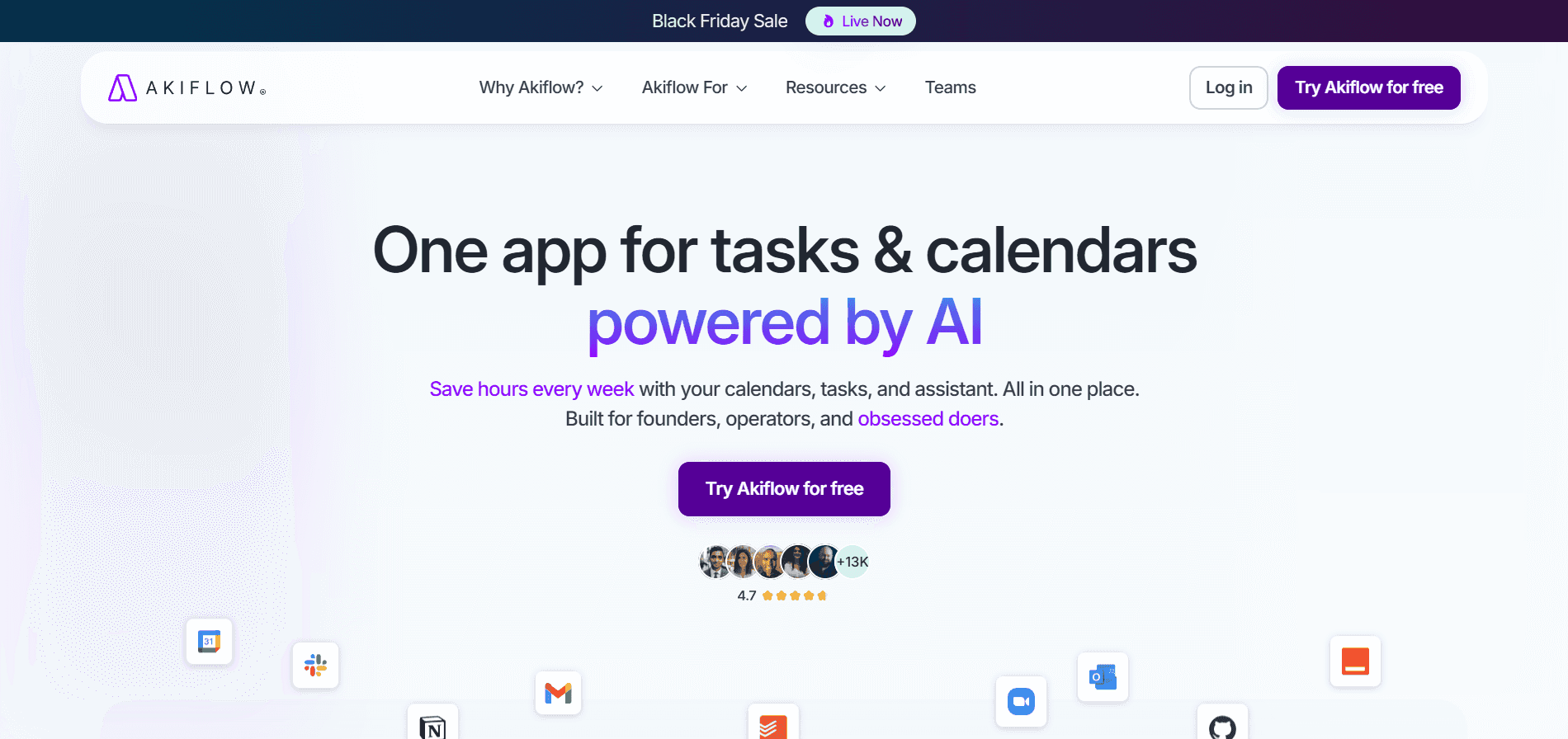
Take control of your team’s workflow and align your chosen project management organizational structure with a platform that brings everything together.
Here’s how Akiflow can support your structure and help you deliver more smoothly:
Unified Inbox: Consolidate tasks from Gmail, Slack, Notion, and Asana into one dashboard, so your structure stays visible and coordinated.
Time-Blocking Made Easy: Drag tasks into calendar slots with color-coding and lockable durations, which supports any structure you choose, functional, hybrid, or network-based.
Team Availability View: Visualize your team’s schedules and availability across functions and projects, making overlaps and bottlenecks easier to spot.
Command Bar & Shortcuts: Quickly create tasks, events, and bookings with keyboard shortcuts, ideal when you’re managing multiple structures or switching contexts rapidly.
Booking Links & Shared Slots: Share your free slots via scheduling links so teams and stakeholders can book time without disrupting your structure’s flow or causing misalignment.
Focus Mode & Analytics: Protect deep-work time and review how you’re allocating resources, roles, and time blocks, crucial for refining whichever structure you adopt.
Also read: Time Management Plan: 6 Strategies To Improve Productivity
Final Thoughts
A well-matched project management organizational structure gives every team the clarity, direction, and flow needed to deliver work without constant friction. Understanding how each structure operates makes it easier to choose one that strengthens accountability, improves collaboration, and supports the pace your projects demand. With alignment in place, Akiflow helps you maintain that momentum by centralizing tasks, organizing schedules, and supporting deeper focus across every structure. Its time-blocking, unified inbox, and scheduling features make day-to-day execution smoother, no matter how your teams are organized.
Try Akiflow for free today and see how streamlined project execution can look for your team.
FAQ
What is a project management organizational structure?
A project management organizational structure outlines how roles, responsibilities, and reporting lines are arranged within a team. It shapes who makes decisions, how information moves, and how smoothly projects progress from planning to completion.
Which organizational structure is best for project management?
There isn’t a single best structure, because the ideal model depends on factors such as team size, project complexity, and the level of autonomy needed. Functional works well for specialized teams, while projectized or hybrid structures suit fast-moving or cross-functional work.
How does organizational structure affect project performance?
The structure influences clarity, communication speed, and resource availability, all of which determine how efficiently a project moves forward. When roles are well-defined, teams experience fewer delays and less friction.
What is the main difference between functional and matrix structures?
Functional structures group people by department, while matrix structures split reporting between a functional lead and a project manager. The matrix model offers more flexibility but requires stronger coordination to avoid confusion.
Why do some teams prefer hybrid organizational structures?
Hybrid structures combine elements from multiple models, giving teams a balance of stability and flexibility. This approach helps organizations adapt to changing priorities without rebuilding their entire system.
How do organizational structures support remote or distributed teams?
Clear structures help distributed teams stay aligned by defining how communication, ownership, and decision-making work across locations. Models like hybrid, team-based, or network-based often support remote collaboration more effectively.


