
You start the day with a plan. Then come the pings, meetings, quick asks, and calendar reshuffles. Before noon, your focus is gone, and the work that really matters hasn’t started.
This isn’t about effort. It’s about where your time is getting pulled.
A 2025 study found that professionals are productive for just 31% of their workday, with the rest lost to interruptions, context switching, and reactive tasks.
The cost adds up: unfinished priorities, long days, and a constant sense of falling behind.
But the problem isn’t random. Most time drains follow a pattern. And when you can see the pattern, you can fix it. This guide breaks down the most common time management problems, what causes them, and how to rebuild your day with structure and clarity; using tools that actually support how you work.
Key Takeaways
Time management problems often look like busyness, not chaos
Interruptions and context switching steal focus
Without a system, urgency drives your day
The issue is poor design, not lack of effort
Fixing it starts with clarity, not more hours
Protect time for what truly matters, or it gets pushed aside
Signs You’re Struggling with Poor Time Management
Poor time management doesn’t always look chaotic. In high-performing environments, it often hides behind packed schedules, constant motion, and the appearance of productivity. Here’s what that looks like beneath the surface:
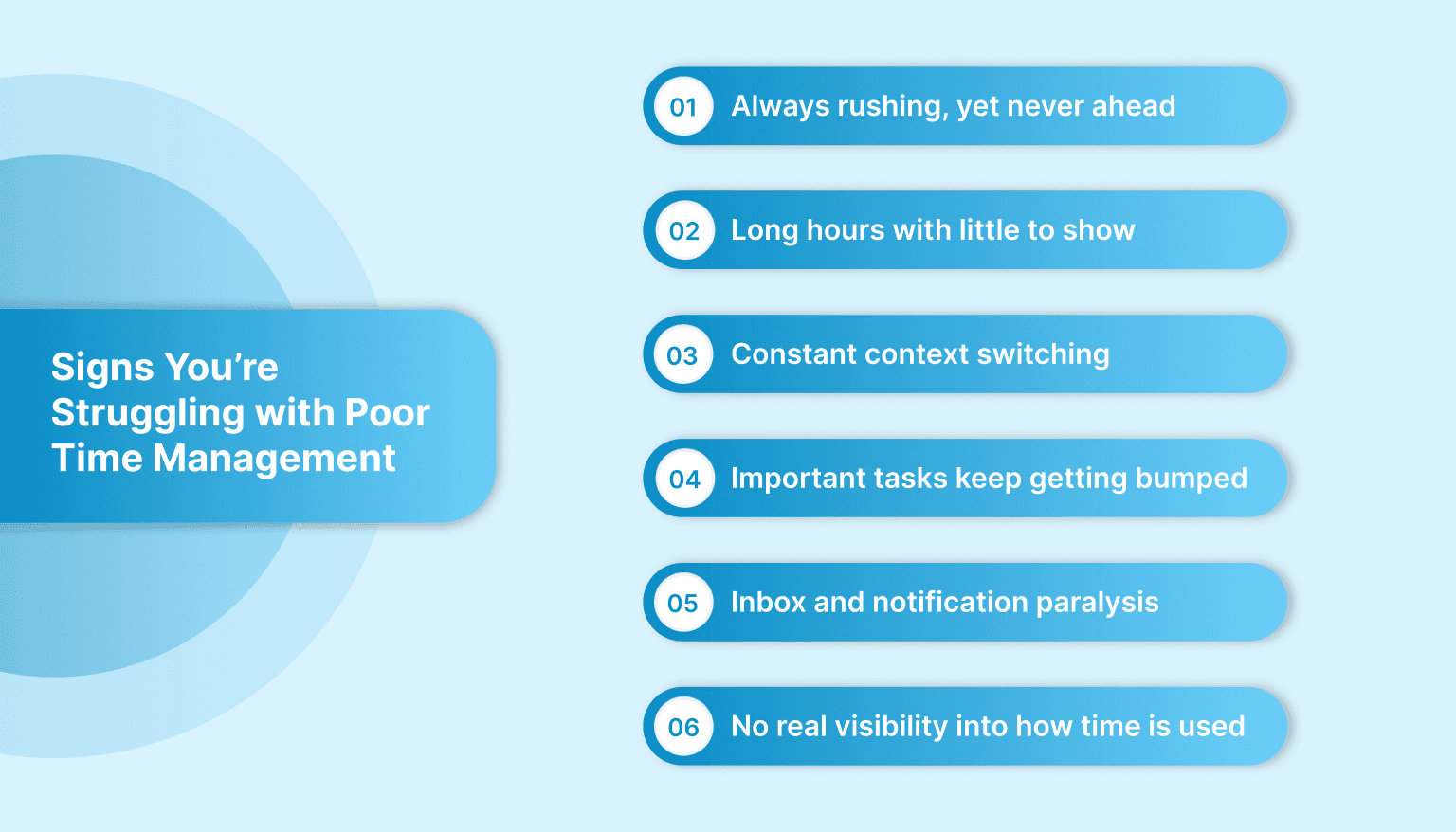
1. Always rushing, yet never ahead
The pace is relentless. You’re not idle, but you’re not in control either. There’s no time to pause, evaluate, or plan. This creates a reactive loop where you’re solving problems created by yesterday’s rush instead of building tomorrow’s progress.
What’s really happening: There’s no intentional buffer built into your schedule. Without room to recalibrate, even small delays compound and turn into emergencies.
2. Long hours with little to show
You’re working more than ever but still missing the mark on meaningful goals. Emails get cleared. Meetings are attended. But key outcomes? Delayed again.
The deeper issue: Time isn’t being allocated based on value. It’s being consumed by visible, urgent, or easy work. Without scheduled time for high-leverage tasks, you end up filling the day instead of moving forward.
3. Constant context switching
You move between tools and conversations, but never settle into real focus. Your brain is always spinning up and slowing down, which burns mental energy even faster than the work itself.
Why it matters: Task-switching reduces working memory, increases mistakes, and stretches simple tasks into half-day distractions. Without structure, tools designed to help become obstacles to clarity.
4. Important tasks keep getting bumped
You know what matters; the strategic project, the deep work block, the planning session but something always seems to come up. These tasks are easy to postpone because there’s no immediate consequence.
What’s going wrong: You’re treating urgent as the default filter instead of designing time around long-term impact. Over time, this leads to stalled progress, missed opportunities, and career drift.
5. Inbox and notification paralysis
You start the day in your inbox. You end the day in your inbox. Somewhere in between, your attention gets fractured by a dozen platforms and a hundred micro-decisions.
The overlooked impact: Your brain enters shallow-response mode. You’re not making progress, you’re processing requests. It feels active, but it’s mostly a passive reaction.
6. No real visibility into how time is used
You know you worked hard. You don’t know what moved forward. This lack of visibility creates a disconnect between effort and outcome; the work feels heavier, the wins feel smaller.
Underlying cause: Without a regular review process or a task-to-calendar system, your perception of time becomes distorted. What feels like a full day often lacks focused time on priority work.
Must read: How to Improve Time Management Skills in 2025: 5 Strategies That Actually Work
What Causes Poor Time Management?
The biggest enemy of time management isn’t distraction. It’s a lack of intentional design. When time is left unstructured, external demands will take over. Below are the core drivers of that drift:
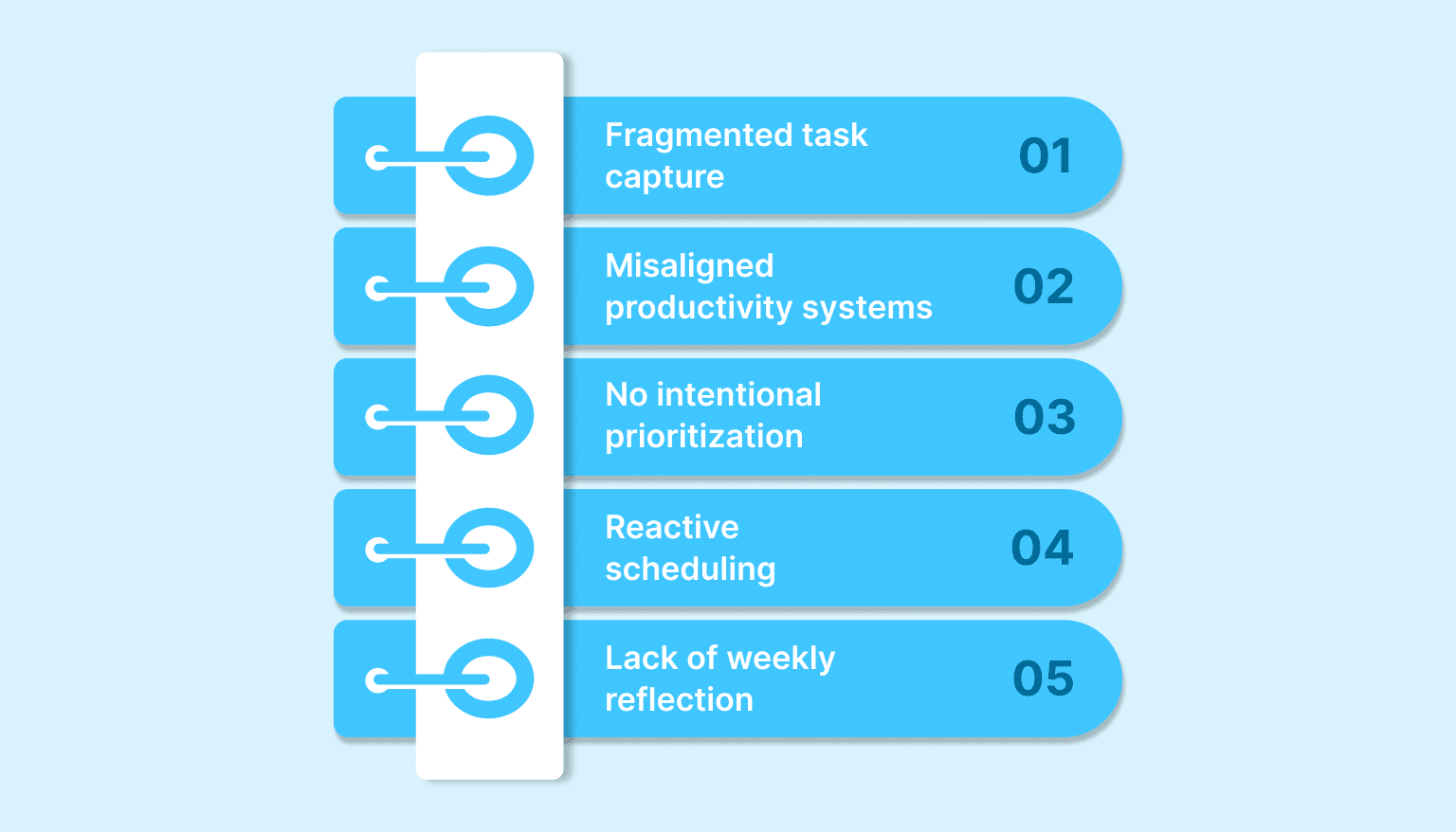
1. Fragmented task capture
If tasks are spread across your inbox, chat apps, voice notes, and memory, your mind is always in scan mode. You’re trying to remember what you promised, what’s urgent, and what slipped through.
This creates anxiety and friction. You’re constantly reviewing instead of executing.
2. Misaligned productivity systems
To-do lists don’t reflect the time you actually have. Calendars show meetings, but not real work. Without alignment between task load and available time, you overcommit and underdeliver.
Result: You think you’re being productive, but the math doesn’t work. There’s more scheduled than fits.
3. No intentional prioritization
Most people default to what’s visible or urgent. Few stop to ask: what’s the most valuable use of my time today? The absence of this question leads to scattered focus and short-term wins at the expense of meaningful progress.
4. Reactive scheduling
When your calendar fills itself through meeting invites and incoming requests, you’re not in control. Even high-value work gets slotted into gaps and leftovers.
Deeper issue: You’re not just missing time for focus, you’re giving it away by default.
5. Lack of weekly reflection
If you never pause to examine where your time went, you’re destined to repeat the same week. You won’t see the patterns, and without seeing them, you can’t correct them.
The cost: Strategic drift, chronic overwhelm, and burnout masked as “high performance.”
Suggested read: 10 Best Scheduling Time Management Methods for Getting Things Done
Proven Solutions to Time Management Challenges
Solving poor time management isn’t about squeezing more into the day. It’s about protecting time for the work that matters and stripping away the noise. High-output professionals don’t just work harder; they build systems that protect focus, reduce friction, and bring clarity to their decisions.
Let’s break down what that looks like in practice.
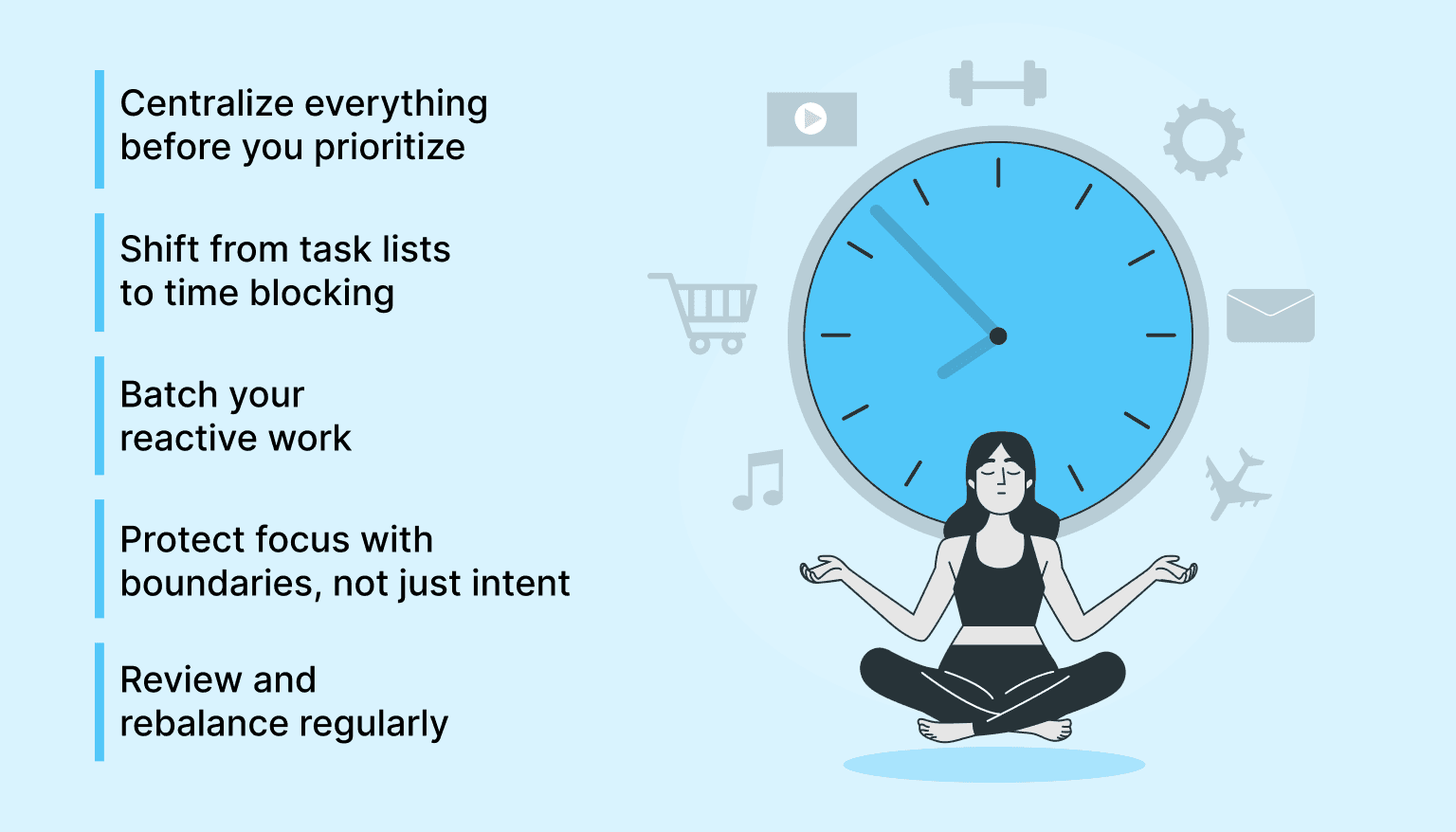
1. Centralize everything before you prioritize
You can’t manage what you can’t see. Most professionals waste hours chasing scattered tasks across apps, messages, and emails. The first step is to bring every task, deadline, and input into one place.
Why it matters: Without a centralized system, your brain becomes the system — and that’s how burnout starts.
2. Shift from task lists to time blocking
A to-do list is infinite. Your calendar is not. If your most important work isn’t on the calendar, it will get buried under whatever’s loudest. That’s why high-performing professionals time-block deep work, strategic planning, and even downtime.
What changes: You stop overcommitting. You start seeing what can realistically be done.
3. Batch your reactive work
Emails and messages aren’t emergencies, they just feel like it. Every time you answer immediately, you reinforce a loop where your time is managed by someone else’s urgency.
The fix: Create intentional blocks for reactive tasks. Answer messages at set times. Don’t start your day in your inbox.
4. Protect focus with boundaries, not just intent
Deep work doesn’t happen by accident. You need to defend it. That means saying no, turning off notifications, and creating real friction between you and distractions.
What works:
Use Do Not Disturb modes
Set meetings only during specific hours
Schedule breaks so you don’t default to distractions
5. Review and rebalance regularly
Productivity isn’t static. What worked last week might not work this one. The only way to improve your time strategy is to reflect on how your week actually went.
Why this matters: Without review, you repeat. With review, you recalibrate.
Must read: The Science of Blocking Time: A Smarter Way to Work
How Akiflow Solves Modern Time Management Problems
Once you understand what’s pulling your time in the wrong direction, the next step is to replace reaction with structure. That’s where Akiflow becomes a daily advantage.
It’s more than just a task manager. Akiflow gives you the tools to actively design your day instead of drifting through it.
1. See everything in one place
Instead of jumping between Slack, Gmail, Notion, and Asana, Akiflow brings all your tasks into a single dashboard. This gives you a real-time view of your workload, so you can act with clarity.
2. Turn tasks into scheduled focus blocks
Tasks aren’t just items on a list. In Akiflow, you can drag them into your calendar to block time for focused execution. This turns planning into commitment, which is where the real progress happens.
3. Prevent small tasks from stealing your day
With smart snoozing, quick commands, and batch-processing options, Akiflow helps you handle small tasks without letting them break your momentum. You stay in control without losing visibility.
4. Build a habit of weekly reviews
Akiflow makes reflection part of your routine. At the end of each week, you can scan what got done, spot where your time went, and rebalance your upcoming week toward more meaningful work.
5. Protect time for what matters
By helping you time-block the right work and mute the noise, Akiflow ensures your important but non-urgent tasks actually get the space they deserve.
If you’re stuck in a cycle of reactive work, Akiflow offers a simple, structured way to shift toward clarity, intention, and execution.
Final Thoughts
Good time management isn’t about filling every hour. It’s about protecting the right hours.
When your day is run by pings, shifting priorities, and scattered tools, your best work slips into the background. That’s not a motivation problem. It’s a system problem.
The Time Management Matrix helps you see the real cost of reactive work. But awareness isn’t enough. You need a tool that turns that awareness into action.
Akiflow helps you stop reacting and start designing your time with intent.
You get clarity. You get structure. You get your focus back.
Ready to take control of your schedule? Try Akiflow today and make time for what actually matters.
FAQs
Q: What is poor time management?
A: Poor time management is the inability to plan and control how your time is spent. It often leads to missed deadlines, low output, and high stress.
Q: What is the definition of bad management?
A: Bad management includes poor planning, weak communication, and lack of prioritization. It creates confusion, burnout, and inconsistent performance.
Q: What are the symptoms of poor time management?
A: Common signs include constant rushing, multitasking without results, long hours with little progress, and frequent delays in important tasks.
Q: What is the solution for poor time management?
A: The solution is building systems that prioritize, schedule, and focus your time. Centralizing tasks, blocking time, and reflecting weekly helps regain control.
Q: What are the risks of poor time management?
A: Left unchecked, poor time management can cause burnout, missed goals, poor work quality, and declining job satisfaction. It can also slow long-term growth.


