
Summary
A small number of tasks usually create most of your results, so identify the work that directly affects long-term goals instead of treating every task as equally important.
Once you know your vital few, protect them with calendar blocks, no notifications, and single-task focus so high-priority work does not get crowded out by routine activity.
Low-value work should be delegated, automated, outsourced, or eliminated, then reviewed regularly because your priorities change and your top 20% today may not be the same next quarter.
In a world where time and energy are limited, the ability to focus on what truly matters can make all the difference between success and burnout. The 80:20 rule, also known as the Pareto Principle, provides a robust framework for achieving better outcomes by focusing on the few tasks that have the greatest impact on your work and productivity.
First described by the Italian economist Vilfredo Pareto in 1896, the 80:20 rule states that 80% of outcomes come from 20% of the effort. In the workplace, this principle translates into a simple truth: a small number of tasks consistently drive the majority of meaningful results. Some tasks and activities will yield far greater results than others, and identifying these high-impact areas is crucial for anyone looking to improve efficiency and make smarter use of their time.
In this blog, we will explore the 80:20 rule in the context of work and productivity. We’ll break down how the principle applies to your daily tasks, how to identify your “vital few” activities, and provide actionable tips to help you implement the rule in a way that maximizes your efficiency, reduces stress, and drives real results.
Understanding the 80:20 Rule in the Context of Work
The 80:20 rule states that 80% of your results come from just 20% of your activities. In a work environment, this could mean that 20% of your clients, tasks, or projects contribute to 80% of your business results. Similarly, 20% of your daily tasks may be responsible for the majority of your productive output.
This rule isn’t about working harder or longer hours; it’s about being strategic with how you allocate your time and energy. By identifying the few tasks that generate the most value, you can shift your focus away from the tasks that don’t matter as much and devote more energy to the areas that truly move the needle.
Why the 80:20 Rule Is So Powerful for Productivity?
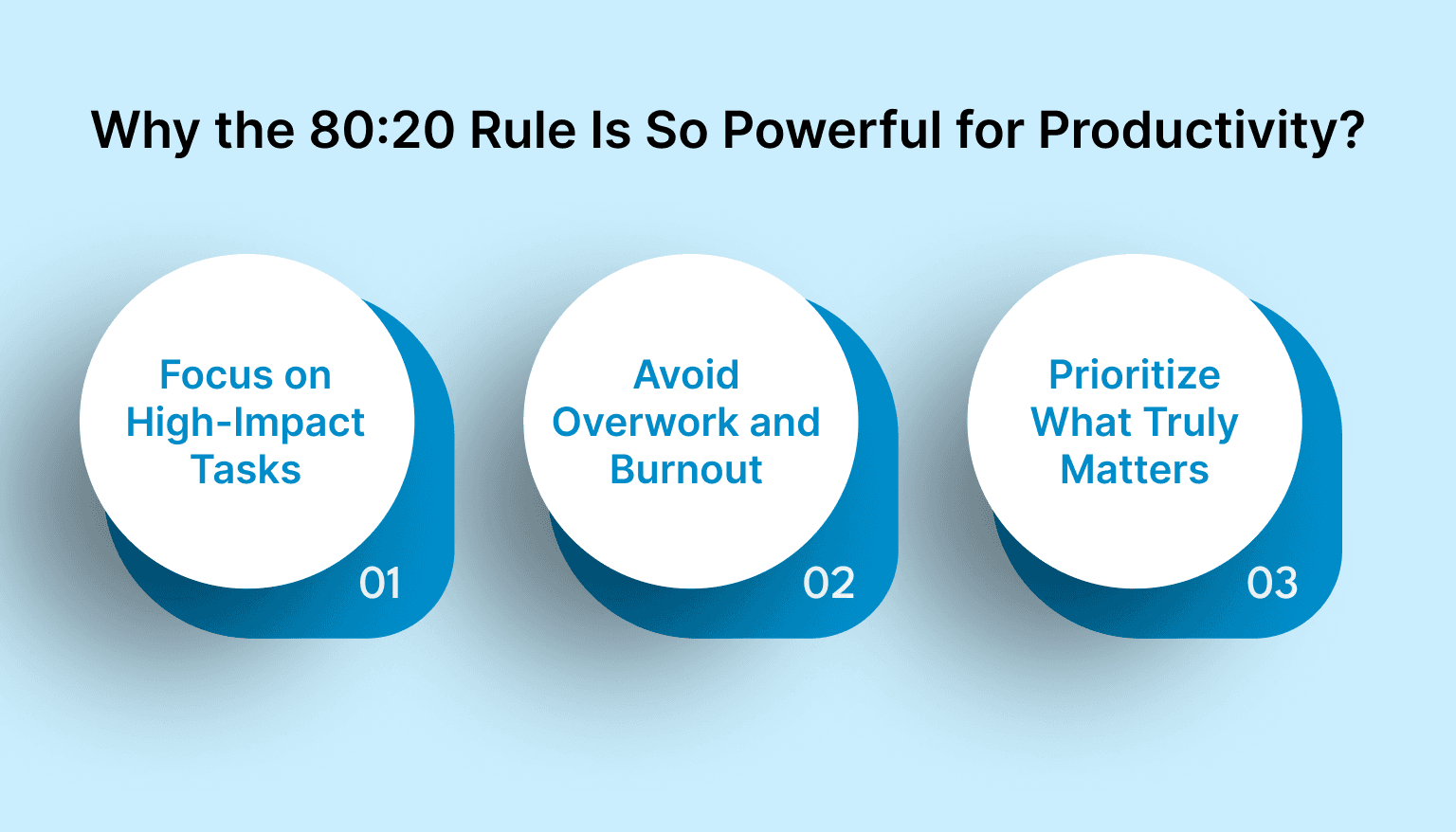
The power of the 80:20 rule lies in its simplicity and the clarity it brings to decision-making. When you start to apply the principle, you’ll quickly realize that many of your daily tasks aren’t contributing as much to your long-term goals as you think.
Let’s see how it helps in productivity.
1. Focus on High-Impact Tasks
By identifying the 20% of tasks that provide the most value, you can dedicate more time to these activities while eliminating distractions and tasks that contribute little to your overall objectives.
2. Avoid Overwork and Burnout
When you’re constantly working on tasks that don’t contribute to your goals, you’re more likely to feel overwhelmed and burned out. The 80:20 rule encourages you to work smarter, not harder.
3. Prioritize What Truly Matters
When you have limited time, prioritizing becomes essential. The 80:20 rule makes it easier to recognize what matters most and allocate your energy accordingly.
Also read: How to Improve Time Management Skills in 2025: 5 Strategies That Actually Work
Examples of the 80:20 Rule at Work
To make the 80:20 rule more practical, it helps to see how it plays out in real roles. While responsibilities differ, the principle stays the same: a small set of actions drives most meaningful outcomes.
Let’s look at how each category can follow this.
For Founders
Founders often juggle strategy, hiring, sales, and operations. In practice, 20% of activities such as closing key partnerships, refining the core product direction, or hiring critical roles account for 80% of business growth. Applying the 80:20 rule means spending less time on routine approvals or minor optimizations and more time on decisions that shape revenue, product-market fit, and long-term direction.
For Developers and Designers
For developers and designers, a small portion of work usually creates the biggest impact. For example, 20% of features or design improvements often account for 80% of user satisfaction or performance gains. Focusing on core functionality, fixing high-impact bugs, or improving critical user flows delivers far more value than polishing low-usage components.
For Managers
Managers influence outcomes primarily through people and priorities. 20% of actions, such as clear goal-setting, meaningful feedback, and removing blockers for the team, often result in 80% of team performance and morale. Applying the 80:20 rule here means spending less time on status updates and more time coaching, prioritizing work, and enabling the team to execute effectively.
How to Apply the 80:20 Rule in Your Daily Work?
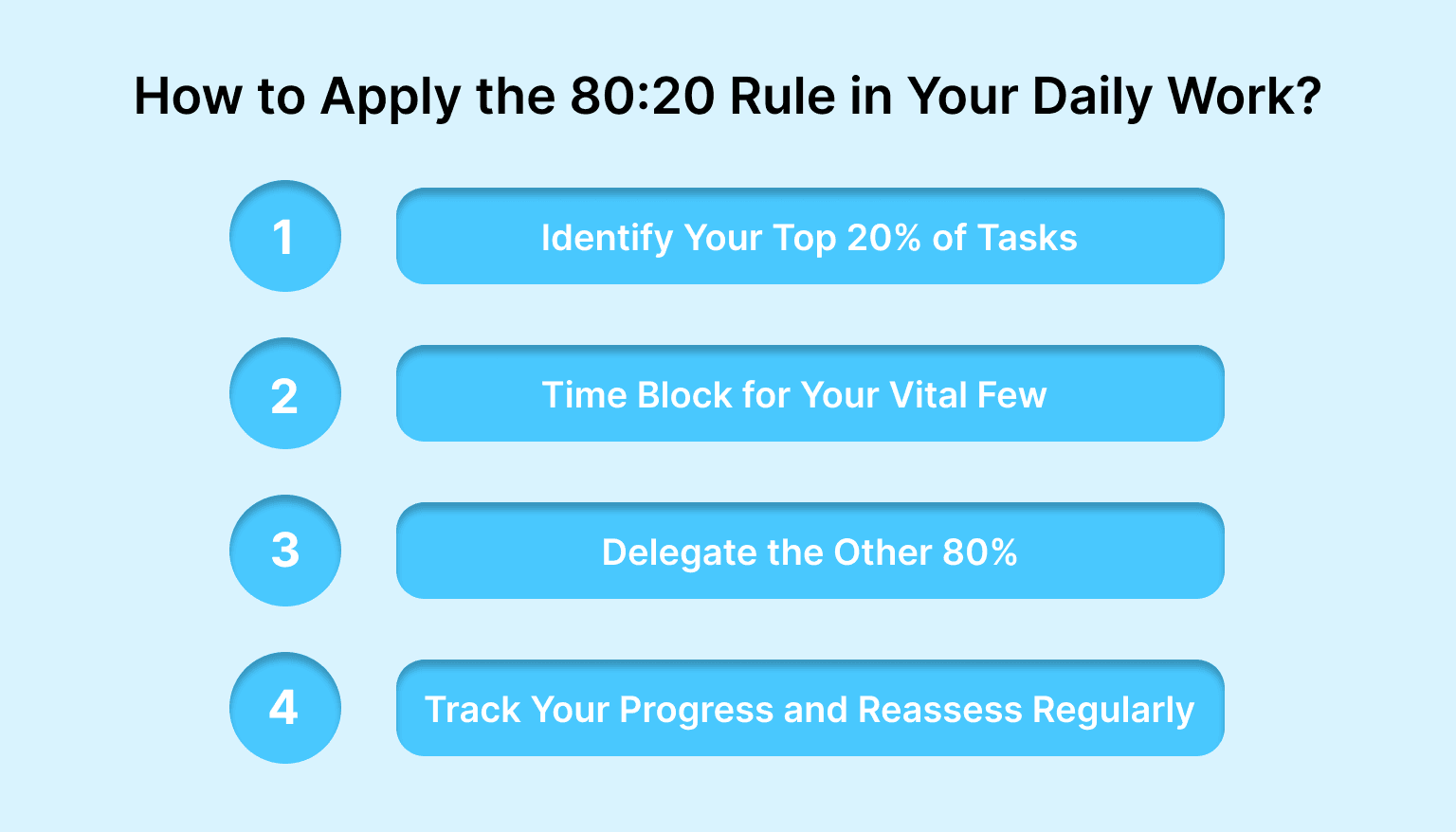
Now that we understand the basic concept of the 80:20 rule, let’s dive into how to apply it in your daily workflow practically. Whether you’re a manager, team leader, freelancer, or remote worker, these tips will help you align your tasks with your highest-priority goals.
Let’s look at how to apply them.
1. Identify Your Top 20% of Tasks
The first step in implementing the 80:20 rule is identifying which 20% of tasks contribute to 80% of your desired outcomes. These tasks are your “vital few,” and they’re the ones that should take priority over everything else.
How to Identify Your Top 20%:
Assess your tasks: List all the tasks you need to complete for the week or month.
Evaluate impact: For each task, ask yourself: Will completing this task have a significant effect on my long-term goals? Focus on high-impact tasks like strategic planning, high-value client meetings, or key creative work.
Use data: If possible, review past performance data to identify which activities yielded the best results (e.g., revenue, growth, customer satisfaction).
Once you’ve identified your key tasks, it’s time to reorganize your day to prioritize these items.
2. Time Block for Your Vital Few
Time blocking is a highly effective way to ensure that your 20% of tasks get the focus they deserve. By blocking off specific periods in your calendar for high-priority tasks, you’re ensuring that these activities don’t get lost in the shuffle.
How to Time Block:
Set aside deep work time: Dedicate uninterrupted blocks to your most important tasks. Treat these blocks as meetings that can’t be moved unless absolutely necessary.
Eliminate distractions: During time blocks, silence notifications, close irrelevant apps, and let others know you’re unavailable for non-urgent matters.
Focus on one task at a time: Multitasking reduces productivity and increases mental fatigue. During your deep work blocks, focus on completing just one task at a time.
3. Delegate the Other 80%
Now that you’ve prioritized your top 20%, what do you do with the remaining tasks? 80% of low-value activities can often be delegated, outsourced, or simply eliminated from your schedule.
How to Delegate Effectively:
Clarify expectations: When delegating tasks, ensure the person you’re assigning them to understands the outcome and timeline.
Use automation: Many administrative tasks, such as scheduling meetings or sending follow-up emails, can be automated with tools.
Outsource when appropriate: For tasks outside your expertise, compare the time and cost of doing the work yourself with delegating it. Set clear expectations and retain a way to review the result.
4. Track Your Progress and Reassess Regularly
The 80:20 rule isn’t a one-time exercise; it works best when revisited regularly as priorities and responsibilities change. As your business or work priorities change, so will your vital few tasks. Make sure to regularly track your progress and reassess your task list to keep yourself aligned with your highest priorities.
How to Reassess:
Weekly reviews: At the end of each week, review what you accomplished and which tasks had the biggest impact. Adjust your priorities accordingly for next week.
Set quarterly goals: Use the 80:20 rule to focus on the long-term goals for the quarter, ensuring your efforts align with your broader objectives.
If identifying your vital few feels clear, but acting on them doesn’t, Akiflow can help. Capture all your tasks in one place, highlight your top 20%, and block time for them so they actually get done. Try Akiflow now!
Benefits of the 80:20 Rule for Personal Productivity
The 80:20 rule isn’t just about improving team productivity; it’s also a game-changer for personal work habits. By applying the principle to your individual tasks, you can reduce stress, enhance your focus, and make your workday more meaningful.
Here are the benefits of the 80:20 rule.
1. Less Overwhelm, More Control
By focusing on your most important tasks and letting go of low-impact ones, you can reduce the overwhelming feeling of having too much on your plate. The 80:20 rule helps you regain control of your schedule by reducing noise and narrowing your focus.
2. Increased Work-Life Balance
When you prioritize tasks that align with your goals, you’ll naturally have more time to focus on the things that matter outside of work. The 80:20 rule encourages you to make time for personal activities, hobbies, and self-care.
3. Better Decision-Making
The 80:20 principle helps clarify which tasks truly move the needle, enabling you to make more strategic decisions about where to invest your time and energy. This leads to smarter work habits and better long-term outcomes.
Must read: The Science of Blocking Time: A Smarter Way to Work
Practical Tools for Applying the 80:20 Rule

To make implementing the 80:20 rule even easier, there are tools designed to help you track tasks, plan your day, and maintain focus. Tools like Akiflow integrate your task list with your calendar, enabling you to time-block effectively and stay on top of your priorities without the overwhelm.
How Akiflow Helps:
Centralized task management: Akiflow allows you to capture all your tasks in one place, so you can focus on your top 20% without the mental clutter of switching between apps.
Time-blocking features: With Akiflow’s time-blocking functionality, you can allocate specific time slots for high-priority tasks and ensure they get done without distractions.
Task prioritization: Using Akiflow’s task prioritization system, you can easily identify your vital few tasks and delegate or reschedule the rest.
Akiflow makes the 80:20 rule practical by turning priorities into a daily plan. Use it to decide what deserves your time today, and what can wait, delegate, or disappear.
Final Thoughts
The 80:20 rule is more than just a time management tactic. It’s a mindset shift that encourages you to focus on what truly matters, rather than getting lost in the noise of day-to-day tasks. By applying the principle to your workday, you can significantly boost your productivity, reduce stress, and create more room for both personal and professional success.
Akiflow helps you turn prioritization into action by aligning your most important tasks with your time.
You gain clarity. You gain control. You gain better results.
Ready to work smarter, not harder? Try Akiflow today and start applying the 80:20 rule to your day.
Frequently Asked Questions
How do I find my vital few tasks without guessing?
Start with a full weekly or monthly task list. Then check each item for impact: will finishing it significantly affect your long-term goals? If you have past data, use that too. Revenue, growth, customer satisfaction, or other outcome measures can show which activities consistently produce the strongest results. Move those tasks to the top of your day.
What should I do with the other 80% of tasks?
Do not assume all of it must stay on your plate. Lower-value work can often be delegated, automated, outsourced, or removed. When you delegate, be clear about the expected outcome and timeline. When work is repetitive, look for automation. Keep your own time for the work that only you can do and that most affects results.
Does the 80:20 rule look different for founders, builders, and managers?
Yes. The pattern stays the same, but the high-impact work changes by role. Founders get more leverage from decisions tied to revenue, product-market fit, and long-term direction. Developers and designers get more from core functionality, high-impact bugs, and critical user flows. Managers create outsized results through goal-setting, feedback, and removing blockers, not by spending more time on status updates.
How do I stop important work from getting buried during the day?
Use time blocks for your highest-priority tasks and treat those blocks like meetings that should not move unless necessary. Protect them by silencing notifications, closing irrelevant apps, and avoiding multitasking. The goal is simple: give your most important work uninterrupted time so it does not disappear under smaller tasks, pings, and context switching.
How often should I reassess my top 20%?
Reassess regularly, not once. A weekly review helps you see which tasks actually had the biggest impact and lets you reset next week’s priorities. Pair that with quarterly goals so your daily choices still match longer-term objectives. This matters because your vital few change as your responsibilities, business needs, and priorities change.


