
Every productivity system promises the same thing: do more with less. But the harsh reality is that most professionals aren't struggling with doing tasks; they're drowning in deciding which tasks deserve their attention.
The focus funnel technique offers a refreshingly simple solution. Unlike traditional time management methods that add complexity, this framework helps you systematically filter every task through five critical decisions. The result? A clear path to what truly matters and the confidence to let everything else go.
This guide breaks down the focus funnel method, shows you how to apply it to your daily workflow, and provides actionable steps to reclaim hours every week.
Key Takeaways
The focus funnel uses five sequential filters: eliminate, automate, delegate, procrastinate, and concentrate, to systematically reduce your task load before you ever consider execution.
Elimination is your most powerful productivity tool, yet most professionals skip it entirely and jump straight to "how do I get this done?"
Strategic procrastination means intentionally delaying tasks until the optimal moment, which is fundamentally different from avoidance-based procrastination.
Only tasks that survive all four filters (can't be eliminated, automated, delegated, or delayed) deserve your concentrated attention and dedicated calendar blocks.
Weekly reviews are essential to prevent task creep and ensure new work is properly filtered through the funnel rather than automatically landing on your plate.
What Is the Focus Funnel?
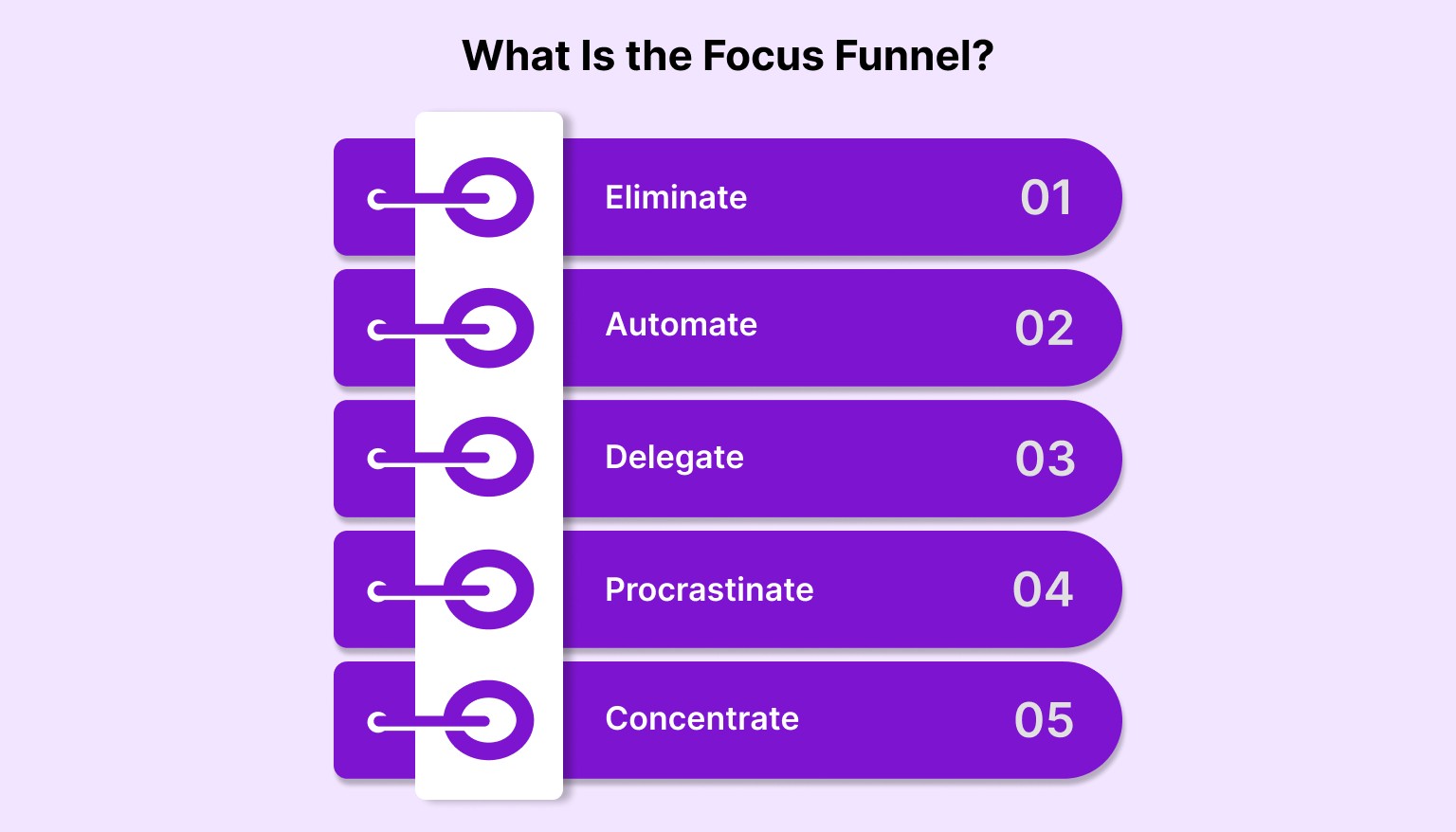
The focus funnel is a decision-making framework that helps you evaluate every task through five sequential questions. Created by productivity expert Rory Vaden and detailed in his book Procrastinate on Purpose, this technique treats your to-do list like a funnel, filtering tasks through increasingly specific criteria until only the most valuable work remains.
Unlike the Eisenhower Matrix, which categorizes tasks into four quadrants, the focus funnel uses a linear, step-by-step process. Each task flows through five distinct stages:
Eliminate — Can this be removed entirely?
Automate — Can this be systematized?
Delegate — Can someone else handle this?
Procrastinate — Should this wait until later?
Concentrate — Is this worth my focused attention now?
The brilliance of funnel focus lies in its simplicity. Instead of agonizing over priorities, you follow a clear decision tree that removes ambiguity from task management.
Must Read: Defining and Understanding Time Management
Why Traditional Prioritization Fails?
Most professionals rely on urgency to guide their decisions. Research from Harvard Business Review shows that knowledge workers spend 41% of their time on tasks that offer little personal satisfaction and could be delegated or eliminated.
The problem isn't a lack of tools or techniques. It's decision fatigue.
When your task list contains 47 items, emails, meetings, projects, and administrative work, your brain defaults to what feels urgent rather than what's actually important. You respond to messages, attend unnecessary meetings, and complete low-value tasks simply because they're in front of you.
Traditional prioritization methods create three specific failures:
Overemphasis on urgency: The Eisenhower Matrix separates urgent from important, but in practice, urgent tasks always win. Your inbox doesn't care about strategic thinking.
No clear elimination criteria: Most frameworks assume every task deserves some attention. They help you organize work but rarely help you say no.
Single-dimension thinking: Ranking tasks by importance ignores the reality that some work can be automated, delegated, or delayed without consequence.
The focus funnel addresses these gaps by forcing you to consider elimination first and concentration last.
The 5 Stages of the Focus Funnel
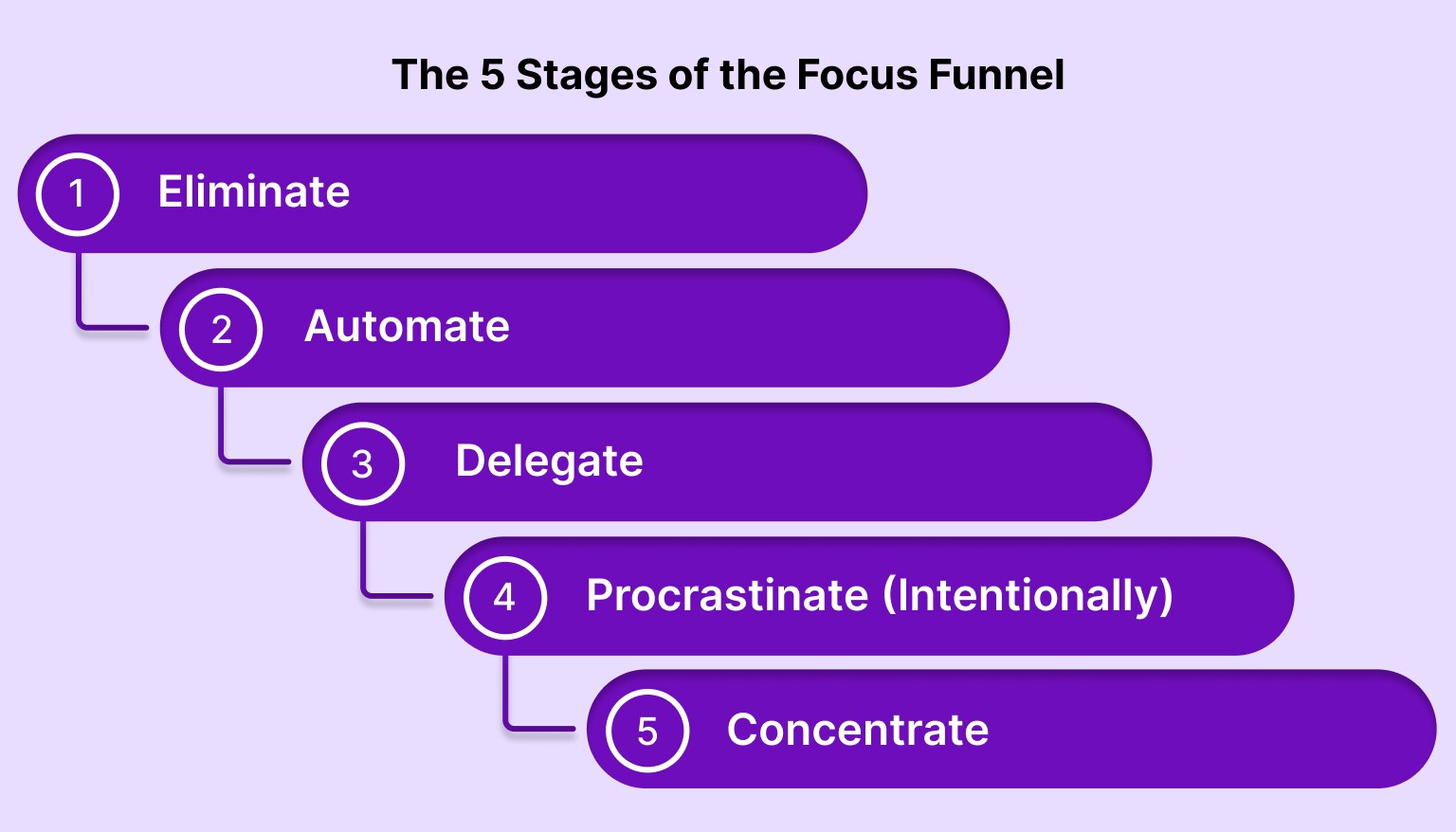
Each stage of the focus funnel builds on the previous one, creating a systematic approach to task evaluation. Let's break down how each filter works and when to apply it.
Stage 1: Eliminate
The first question is the most powerful: Does this task need to exist at all?
Most professionals skip this step entirely. They assume that if something landed on their desk, it must require action. But according to productivity research from McKinsey, up to 28% of a knowledge worker's work week is spent on unnecessary tasks and low-value activities.
Ask yourself:
What happens if this doesn't get done?
Is this task aligned with my core responsibilities?
Am I doing this out of habit rather than necessity?
Elimination isn't about being lazy. It's about protecting your capacity to work on what actually matters.
Stage 2: Automate
If a task can't be eliminated, ask: Can this be systematized or automated?
Automation doesn't always mean complex software. It includes templates, saved replies, keyboard shortcuts, and simple workflows that reduce manual effort.
According to Gartner research, professionals who automate repetitive tasks save significant time weekly. That translates to hundreds of hours annually, the equivalent of a full month of work.
Automation opportunities include:
Email filters and rules that sort messages automatically
Template responses for common questions
Scheduled social media posts
Automated expense tracking and invoicing
Calendar scheduling tools that eliminate back-and-forth emails
The focus funnel encourages you to invest time up front in building systems that pay dividends forever.
Stage 3: Delegate
If automation isn't possible, consider: Can someone else do this task?
Delegation fails for two reasons. First, many professionals believe delegating takes longer than doing the work themselves. Second, they struggle with perfectionism and convince themselves that no one else can meet their standards.
Both beliefs are costly. Research from Harvard Business Review found that leaders who delegate effectively are 33% more likely to work for high-growth companies and report greater team satisfaction.
Effective delegation through the focus funnel requires clarity:
Who has the skills or capacity to handle this?
What outcome do I need, not what process should they follow?
How can I provide context without micromanaging?
Delegation isn't about offloading work randomly. It's about matching tasks to the person best equipped to execute them.
Also read: Time Management Tips to Help Team Leaders Lead Smarter
Stage 4: Procrastinate (Intentionally)
If a task reaches this stage, it's important but not urgent. The focus funnel asks: Is now the right time to do this?
This stage contradicts conventional wisdom. We're taught that procrastination is the enemy of productivity. But Vaden argues that strategic procrastination, delaying tasks until the optimal moment, is actually a form of prioritization.
The key distinction is intentional delay versus avoidance:
Avoidance procrastination: Delaying a task because it feels difficult or uncomfortable.
Strategic procrastination: Delaying because the timing isn't right or because other work takes precedence.
When to intentionally procrastinate:
Projects that depend on information you don't have yet
Tasks that become easier or more efficient at a specific time
Work that's important but doesn't align with current quarterly goals
The focus funnel gives you permission to deliberately delay work, freeing capacity for higher-priority items.
Stage 5: Concentrate
If a task survives all four previous filters, it deserves your complete attention. This is where deep work happens.
Tasks that reach the concentration stage share common characteristics:
Only you can do them
They align with your core responsibilities
They create disproportionate value
They require focused, uninterrupted thought
Cal Newport's research on deep work shows that professionals who protect concentrated time blocks produce higher-quality output in less time than those who work in fragmented intervals.
Concentration requires protection:
Block specific time slots for this work
Eliminate distractions (close email, silence notifications)
Set clear boundaries with colleagues
Work in focused sprints with defined endpoints
A productivity tool like Akiflow can help you centralize these high-priority tasks and block dedicated time for concentrated work, ensuring your calendar reflects your actual priorities.
How to Implement the Focus Funnel in Your Daily Workflow
Understanding the framework is one thing. Applying it consistently is another.
Step 1: Capture Everything
Start by listing every recurring task, project, and commitment. This includes meetings, emails, administrative work, strategic projects, and personal tasks.
Don't filter yet. Just capture. Most professionals underestimate their task load by 40-60% because they haven't externalized it.
Step 2: Run Each Task Through the Funnel
Work through your list systematically. For each item, ask the five focus funnel questions in order:
Can I eliminate this?
Can I automate this?
Can I delegate this?
Should I procrastinate on this?
Does this need my concentrated attention?
Be ruthlessly honest. The goal isn't to keep everything, it's to protect your capacity for what matters most.
Step 3: Create Action Categories
Based on your funnel analysis, organize tasks into four categories:
Eliminated: Remove from your task list entirely. Set up filters to prevent these from returning.
Automated/Delegated: Build the systems or hand off the work. Schedule time to create templates, set up automation, or brief the person taking over.
Procrastinated: Move to a future date with a specific trigger. "Review Q3 product roadmap" goes on your calendar for early Q3, not today.
Concentrated: These are your actual priorities. Schedule specific time blocks for this work.
Step 4: Time Block Your Concentration Work
Concentration tasks deserve calendar slots, not just spots on a to-do list. Schedule your concentration work during your peak energy hours. For most professionals, this is the first 2-3 hours of the workday before meetings and interruptions accumulate.
Step 5: Review Weekly
The focus funnel isn't a one-time exercise. Schedule 30 minutes weekly to run new tasks through the framework and adjust your calendar accordingly.
Ask yourself:
What new tasks appeared this week?
What concentration work didn't get done, and why?
What can I eliminate, automate, or delegate before next week?
This regular review prevents task creep and keeps your attention aligned with your priorities.
Also read: 10 Best Scheduling Time Management Methods for Getting Things Done
Common Mistakes and How to Avoid Them
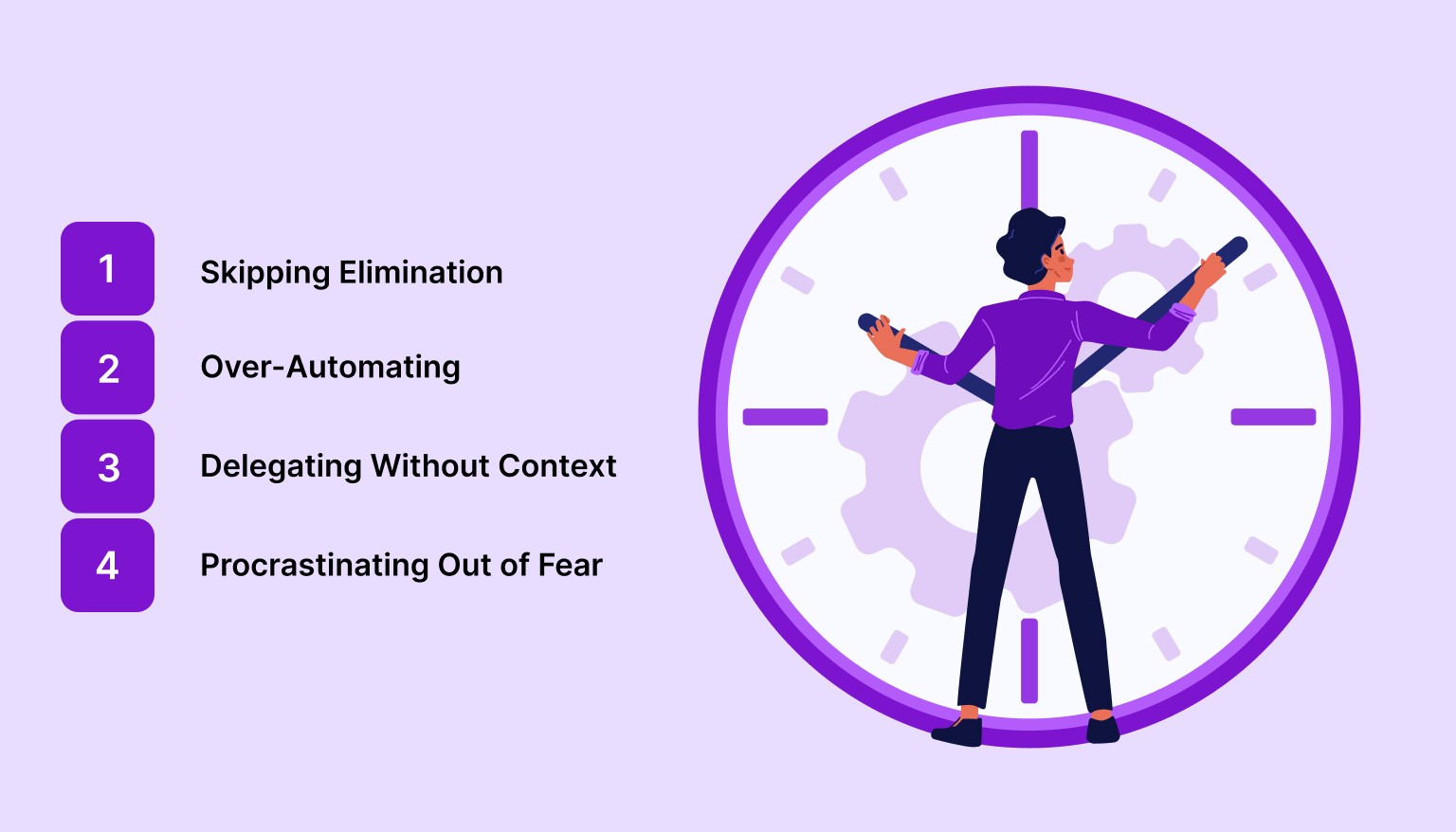
Even with a clear framework, it's easy to fall into traps that undermine the effectiveness of the focus funnel. Here are the most common pitfalls and how to sidestep them.
Mistake 1: Skipping Elimination
The focus funnel only works if you honestly evaluate elimination first. Most professionals immediately jump to "How do I get this done?" rather than "Does this need to happen at all?"
Fix: Force yourself to answer the elimination question for every single task, even if the answer seems obvious. You'll be surprised how often tasks exist purely out of habit.
Mistake 2: Over-Automating
Automation is powerful, but it's not always the answer. Some tasks require human judgment, nuance, or relationship-building that no system can replicate.
Fix: Automate repetitive, rules-based tasks. Keep tasks that require creativity, emotional intelligence, or strategic thinking in the concentrate category.
Mistake 3: Delegating Without Context
Handing off a task without clear expectations creates more work, not less. The person you delegate to will interrupt you repeatedly for clarification.
Fix: When delegating, provide three things: the desired outcome, the deadline, and any constraints or preferences. Let the person own the process.
Mistake 4: Procrastinating Out of Fear
Strategic procrastination means delaying for the right reasons. If you're procrastinating because a task feels intimidating, that's avoidance, not a lack of focus.
Fix: If a task keeps appearing in the "procrastinate" category week after week, it probably belongs in "concentrate." Schedule it and commit to starting, even if imperfectly.
Also read: 7 Simple To-Do List Templates to Master Time Management
Combining the Focus Funnel with Time Blocking
The focus funnel decides what deserves your attention. Time blocking decides when you'll give it that attention.
These two methods work seamlessly together. Once you've filtered tasks through the funnel, your concentrate category becomes your time-blocking priority list.
Integration workflow:
Run weekly tasks through the focus funnel
Identify your concentrate category items
Schedule specific calendar blocks for this work
Protect those blocks as fiercely as you would a client meeting
A productivity tool like Akiflow helps you visualize this integration by centralizing tasks from multiple sources and enabling drag-and-drop time blocking directly on your calendar.
Conclusion
The focus funnel transforms time management from an optimization problem into a filtering problem. Instead of trying to do everything faster, you systematically identify what doesn't need to be done at all.
The five-stage framework, eliminate, automate, delegate, procrastinate, concentrate, gives you a clear decision path for every task that crosses your desk. Most importantly, it protects your capacity for the small percentage of work that creates disproportionate value.
Start small. Choose one recurring task this week and run it through the funnel. Ask yourself honestly whether it can be eliminated, automated, delegated, or delayed. You'll be surprised how often the answer is yes.
Ready to take control of your schedule? Try Akiflow today to centralize your tasks and block time for what truly matters. Start your free trial and reclaim hours every week.
FAQs
1. How is the focus funnel different from the Eisenhower Matrix?
The Eisenhower Matrix categorizes tasks by urgency and importance. The focus funnel is a step-by-step filter that reduces tasks first, then helps you focus on what truly matters.
2. Can the focus funnel work for personal tasks, not just professional ones?
Yes, it works for personal life too. You can eliminate, automate, or delegate chores and focus more on meaningful activities and relationships.
3. How often should I review my tasks using the focus funnel?
A weekly review works best for most people. High-volume roles may benefit from a short daily review for new or urgent tasks.
4. What if my boss keeps assigning tasks that should be eliminated?
Use the funnel to clearly discuss trade-offs. Ask what should be removed or delayed so you can focus on the highest-value work.


