
Summary
Treat constraints as the delivery limits you must plan around, not as surprises to fix later. Scope, time, and cost set the core boundaries, while capacity and tools shape what is realistic.
Expect pressure to show up in specific places: shared people, missing skills, scattered updates, outside partners, compliance rules, weak systems, slow approvals, market shifts, and overloaded teams.
Handle constraints with structure: surface them early, rank the ones creating the most pressure, map ripple effects, add buffer time, review them throughout the work, and keep updates centralized.
Feeling like projects keep slipping through the cracks because time, budget, or team capacity weren’t fully mapped? When tasks scatter across tools and deadlines stack up, confusion replaces clarity, and productivity takes a hit. According to the Bureau of Labor Statistics, productivity in the U.S. non-farm business sector increased only 3.3 % in Q2 2025, highlighting how even small inefficiencies can ripple across workflows. Understanding common project constraints and learning how to manage them lets you reclaim control, streamline your schedule, and free up energy for the work that really moves the needle.
What Are Project Constraints?
Project constraints define the limits you must work within, shaping how much can be delivered and how quickly progress can realistically happen. These boundaries influence your scope, timeline, budget, and overall execution, especially when team capacity or tools are stretched. Every project you handle comes with conditions that affect speed, quality, and outcomes, whether you plan for them or not. A solid understanding of project management constraints puts you in a stronger position to prevent surprises and keep everything aligned with your goals.
Once the basics are clear, it helps to see how these constraints actually influence day-to-day decisions, which is what we’ll look at next.
How Do Constraints Affect Project Success?
Knowing how constraints shape decisions helps you avoid misalignment, delays, and unnecessary rework.
Here are the key ways they influence your ability to deliver successfully:
Constraints force smart trade-offs that push you to adjust scope, deadlines, or cost before they become blockers, keeping your workflow realistic and manageable.
Constraints surface bottlenecks earlier, giving you clarity on workload limits, missing skills, or timing issues long before they create project-wide slowdowns.
Constraints sharpen your prioritization, helping you focus attention and resources on the tasks that actually move the project forward when things tighten.
Constraints strengthen stakeholder alignment by setting clear boundaries everyone must respect, reducing friction, last-minute changes, and competing expectations.
Also read: Master Project Management Frameworks to Boost Team Productivity
These effects become even clearer when you look at the classic model used in most projects, so the following section unpacks that framework.
The Core Triangle of Project Constraints
This model defines how Scope, Time, and Cost create the boundary conditions you must balance when delivering any project.
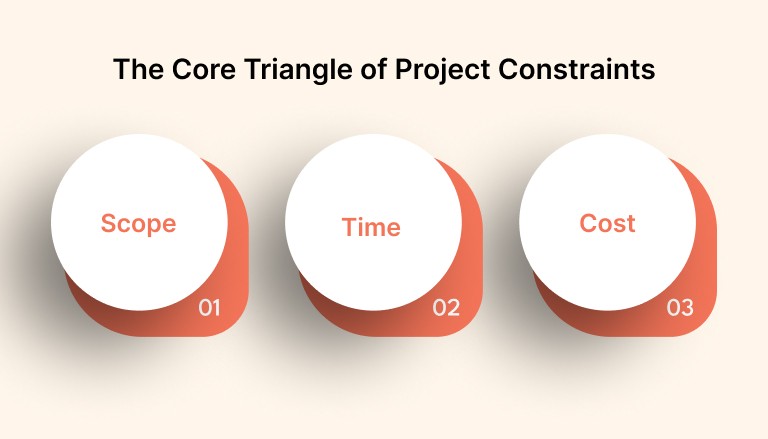
Here’s how each constraint directly shapes your decisions and the trade-offs you make:
Scope
The amount of work locked into the project determines how complex your planning becomes, especially when every feature or requirement adds more coordination, testing, or documentation.
Any shift in Scope forces you to recalculate workload, revisit priorities, and renegotiate expectations with stakeholders before the project drifts off course.
Scope clarity often dictates how confidently you can allocate resources without overcommitting your team or creating conflict between parallel tasks.
Time
Deadlines influence the pace of execution, the room you have to refine work, and how many iterations are realistically possible before final delivery.
Limited Time pushes you to simplify processes, compress stages, or eliminate tasks that don’t directly drive the intended outcome.
Even small scheduling slips compound quickly, creating pressure that affects decision quality, team energy, and downstream milestones.
Cost
Budget controls who can be assigned, what tools can be used, and how much flexibility you have when unexpected issues arise.
Constrained Cost makes trade-offs unavoidable; fewer resources, reduced expertise, or delayed procurement often shift risk onto other parts of the project.
A tight budget increases the importance of prioritizing high-impact work and cutting low-value tasks to avoid stretching your team thin.
Beyond these three boundary points, real projects deal with many more pressures, so the next section covers examples that show what teams face in practice.
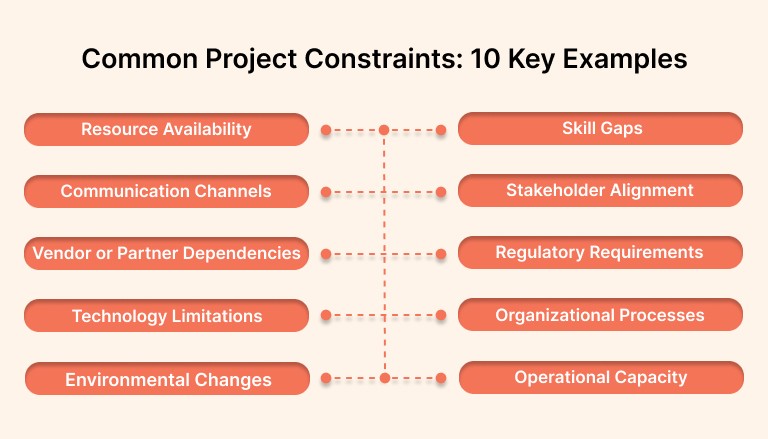
Common Project Constraints: 10 Key Examples
Projects feel smoother when the constraints shaping them are visible from the start. These examples reflect the real frictions that show up in fast-paced teams and remote-first environments where communication, clarity, and capacity can shift quickly.
Resource Availability
Resource availability becomes a constraint when crucial contributors support several initiatives simultaneously, making your progress dependent on unpredictable bandwidth. Delays rise quickly because tasks wait for the specific knowledge or context that only those individuals hold. Stress builds across your team since every schedule adjustment impacts planning, communication, and client expectations. Momentum feels fragile when you constantly adjust timelines around limited access to the right expertise.
Skill Gaps
Skill gaps create friction when your team encounters tasks that require deeper technical or strategic knowledge than they currently possess. A formal process for mapping skills against project needs can reveal these shortages before work is assigned. Productivity drops because you spend additional time researching solutions, testing options, and validating unfamiliar approaches. Timelines stretch even further when you need to involve external experts or shift work to contractors. Energy drains quickly when execution and learning compete for your attention during the same sprint cycle.
Communication Channels
Communication becomes a constraint when project updates scatter across multiple tools, leaving you unsure where the most accurate information lives. Misalignment grows because teammates act based on outdated or incomplete details that never reached the right person. Deadlines slip as decisions get delayed while everyone tries to confirm what the current plan actually is. Remote and hybrid teams feel the impact most because your communication rhythm loses structure without consistent channels.
Stakeholder Alignment
Stakeholder alignment becomes difficult when leaders prioritize different outcomes and expect your team to satisfy competing directions. Scope expands without warning because last-minute ideas get introduced after work is already underway. Morale dips as contributors redo tasks that were previously approved but suddenly no longer match the shifting vision. Planning becomes stressful when you constantly reassess what stakeholders truly want from the final deliverable.
Vendor or Partner Dependencies
Vendor dependencies slow execution when external partners deliver assets, integrations, or approvals later than promised, leaving you stuck until they move. Hidden delays appear frequently because you lack visibility into their internal workload or process. Your schedule becomes unstable as every slip forces re-prioritization for your entire team. Risk increases significantly because your project momentum relies on organizations you cannot directly manage.
Compliance and Regulatory Requirements
Compliance requirements add weight to your project because each decision must meet legal, security, or industry-specific standards. Work takes longer as you incorporate extra documentation, validation, and approval layers into the process. Design and solution flexibility shrink when regulations dictate what you can and cannot implement. Mistakes become costly, pushing you to slow down even when deadlines demand speed.
Technology Limitations
Technology constraints appear when your systems cannot support features, integrations, or automations that would streamline your work significantly. Your team resorts to manual processes that consume time better spent on strategic tasks. Collaboration slows because your tools do not communicate smoothly with each other or with external platforms. Innovation stalls whenever you hesitate to propose improvements due to the limits of your existing tech stack.
Organizational Processes
Internal processes become constraints when approval workflows involve too many steps, forcing you to wait longer for decisions that should be quick. Team energy drops because repetitive administrative tasks interrupt productive focus. Schedules extend as each deliverable passes through several reviewers with different criteria. Even straightforward initiatives feel heavier because your company’s operational structure moves more slowly than your project pace.
Market or Environmental Changes
Market shifts disrupt your plans when customer priorities evolve faster than your project timeline allows. Competitive moves force you to refine features, messaging, or Scope to maintain relevance. External events introduce uncertainty, pushing you to revisit assumptions and update your roadmap frequently. Flexibility becomes essential because staying rigid risks delivering solutions that no longer match current needs.
Operational Capacity
Operational capacity becomes a constraint when your team handles more work than the available bandwidth can realistically support. Teams that adopt operational planning software can catch these bandwidth gaps before they turn into missed deadlines. Focus drops because constant context switching interrupts deep execution and reduces overall quality. Pressure increases as deadlines approach while energy levels decline across the team. Projects slip even with strong planning because capability becomes the bottleneck rather than strategy or intent.
Also read: Best Project Scheduling Software for Effective Management
Knowing the common constraints is useful, but the real value comes from handling them wisely, which you’ll see in the next part.
How to Manage Project Constraints?
Managing constraints becomes easier once you understand how each limitation influences the pace, quality, and predictability of your workflow. Here’s a clear breakdown to help you handle them with more structure and confidence.
Effective Ways to Manage Project Constraints:
Identify constraints as early as possible
Early discovery helps you understand where progress may slow and gives you more control over planning.
Teams adjust more effectively when you surface bandwidth gaps, tool limitations, or unclear requirements before execution.
Visibility at the start prevents unrealistic timelines from forming around hidden blockers.
Rank the constraints that create the most pressure
Prioritizing helps you focus effort on the single factor that affects delivery more than everything else.
Pressure decreases when you allocate resources based on actual impact instead of treating all issues equally.
Decisions become more confident because your team knows which constraint truly drives the project’s pace.
Map how one constraint influences several others
Interdependencies reveal how small shifts in scope, resources, or timelines ripple through the entire project.
Teams avoid last-minute surprises because they anticipate delays before they surface.
Better mapping ensures each department understands how its work affects everyone else’s schedule.
Add buffer time to protect the project flow
Buffers help you absorb delays from approvals, reviews, or integration work without derailing the timeline.
Quality improves because the team isn’t pressured to rush critical decisions.
Work feels more sustainable when timelines respect the natural pace of deep execution.
Make small, continuous adjustments instead of large resets
Iterative recalibration keeps the project stable even when external conditions shift suddenly.
Frequent, lighter updates reduce friction for remote teams who rely heavily on communication clarity.
Momentum stays intact because changes integrate smoothly rather than overwhelming the team at once.
Communicate constraints openly with stakeholders
Transparent communication builds alignment and prevents misinterpretation of shifting priorities.
Everyone understands why timelines change and what limitations shape those decisions.
Trust increases because your reasoning is clear, structured, and proactive.
Use central tools to increase visibility and reduce confusion
Centralized workflows like Akiflow eliminate scattered updates and help your team operate from one source of truth.
Productivity improves when you spend less time searching through different platforms for details.
Real-time visibility lets you adapt quickly when constraints evolve unexpectedly.
Review constraints throughout the entire project lifecycle
Regular evaluation helps you catch new blockers early and adjust before momentum slows.
Teams stay aligned because updates reflect the current reality, not outdated assumptions.
Continuous oversight keeps the project healthy from start to finish.
Tools can make this process easier when tasks, schedules, and priorities get pulled in different directions, so the following section introduces one that supports this workflow well.
How Akiflow Helps You Manage Project Constraints?

Akiflow gives you a structured workspace that helps reduce the impact of time, resource, and communication constraints that slow projects down. Here’s how Akiflow directly supports better constraint management:
Universal Inbox Integration: Akiflow imports tasks from 3,000+ apps into a single inbox, reducing the “scattered task” constraint and maintaining clarity. When you track everything from Slack, Notion, email, and more in one place, you avoid double-handling and save team time.
Time-Blocking Calendar + Task Scheduling: You can drag tasks directly into calendar slots, turning to-dos into scheduled commitments and reducing the “time” constraint by giving tasks a clear slot. This visual scheduling helps you balance meetings and deep-work blocks, lowering the risk of over-booking or resource overlap.
AI Assistant “Aki” for Smart Flow: Akiflow’s built-in AI lets you say things like “Push everything non-urgent to tomorrow,” and it automatically adjusts tasks and time slots, helping with shifting constraints like scope or stakeholder change. By letting you automate routing and prioritisation, you free up focus and respond faster when constraints evolve.
Team Visibility & Resource Coordination: You and your team can see shared calendars and availability in real time, tackling the “resource” and “partner dependency” constraints by synchronizing efforts instead of relying on manual status updates. With co-worker schedules visible, planning becomes smoother and bottlenecks become obvious before they escalate.
Final Thoughts
Managing project constraints becomes far easier once you understand how each limitation shapes your timeline, workload, and overall execution flow. Recognizing these pressure points early gives you the clarity needed to make smarter decisions and keep your projects moving smoothly. Akiflow strengthens this process by centralizing your tasks, scheduling your workload realistically, and helping you stay adaptable when constraints shift unexpectedly. Its time-blocking, prioritization, and focus-driven features support the consistency and visibility needed to manage constraints with confidence.
Try Akiflow for Free to see how Akiflow can streamline your workflow and help you handle project constraints more effectively.
FAQ
What are project constraints in simple terms?
Project constraints are the limitations that shape how a project is planned, executed, and delivered. These include factors like time, resources, budget, stakeholder expectations, and external conditions. Understanding them early helps you create more realistic plans and avoid unnecessary delays.
How do project constraints impact project success?
Constraints influence the pace, depth, and quality of your work by setting boundaries around available capacity. When one constraint tightens, like time or resources, it usually affects others and requires quick adjustments. Managing them well helps you maintain momentum and deliver predictable outcomes.
What is the best way to identify constraints before starting a project?
Clear discovery sessions, team check-ins, and early requirement reviews make hidden blockers easier to spot. These steps give you insight into workload limits, stakeholder expectations, and external dependencies before they cause friction. Early identification makes planning smoother and far more accurate.
Why do constraints change during a project?
Constraints often shift because priorities evolve, new information surfaces, or external conditions change. Projects operating across multiple teams or tools are especially sensitive to these shifts. Continual monitoring helps you adapt to change without derailing progress.
How can a team stay aligned when multiple constraints overlap?
Regular communication and shared visibility help teams understand how each limitation affects the work ahead. When everyone sees the same schedule, workload, and priorities, decisions become faster and more coordinated. Alignment keeps the team stable even when constraints tighten unexpectedly.


