Why Is Time Management Important for Students in 2026? A Complete Guide

11
Being a student in 2026 means juggling much more than lectures and homework. Many students balance classes with part‑time jobs, internships, clubs, side projects, social life, and even freelance work. With so much to do, understanding how to manage your time is no longer optional; it shapes how well you perform, how you feel, and how you prepare for life after school.
Real data shows how common this challenge has become. In 2025 research, 47 percent of students said time management was one of their top three challenges when studying. This highlights that nearly half of students struggle to organise their study time and priorities effectively.
This statistic is not just a number. It reflects how students often feel overwhelmed by competing demands and unclear schedules. When tasks and deadlines pile up without a clear plan, stress increases, productivity drops, and academic goals feel harder to reach.
That is where time management matters. It helps you see your commitments clearly, plan when to work on them, and protect time for focused study and rest. In the sections that follow, we will explain why time management is so important for students, common mistakes to avoid, and practical approaches you can use to improve how you organise your days.
Key Takeaways
Time management is one of the top challenges for students in 2026, with 47 percent citing it as a major obstacle to academic success and mental clarity.
Good time management is not about doing more, but about doing the right work at the right time. It helps reduce stress, improve academic performance, and make space for valuable experiences beyond the classroom.
Students often struggle not because they lack motivation, but because they lack systems. Common mistakes include working from scattered task lists, underestimating energy levels, and letting urgency dictate priorities.
Effective strategies include weekly planning sessions, protecting focus blocks, breaking large tasks into smaller steps, and reviewing past weeks to improve future planning.
A reliable time management system starts with capturing everything in one place. This reduces mental overload and helps turn intention into execution.
What Is Time Management for Students?
Time management is the ability to plan and organise how you spend your time across different tasks, responsibilities, and goals. For students, this means setting clear priorities and using tools or routines to stay on track with studies, assignments, part-time work, and personal time.
Good time management doesn’t mean packing your schedule full. It means being intentional with your hours so that important work gets done without sacrificing focus, rest, or quality.
It includes:
Planning ahead for deadlines and exams
Breaking larger tasks into smaller steps
Creating a daily or weekly routine
Protecting time for study, rest, and other commitments
Knowing when to say no to avoid overload
Students who understand how to manage their time have more clarity during the week, more control over how they spend their energy, and more space for the things that matter most.
Why Is Time Management Important for Students?
Time management is not just about getting more done. For students, it plays a critical role in shaping how effectively they learn, how they handle competing responsibilities, and how they prepare for opportunities beyond academics. When time is planned well, students are more likely to work with clarity, finish what they start, and stay resilient under pressure.
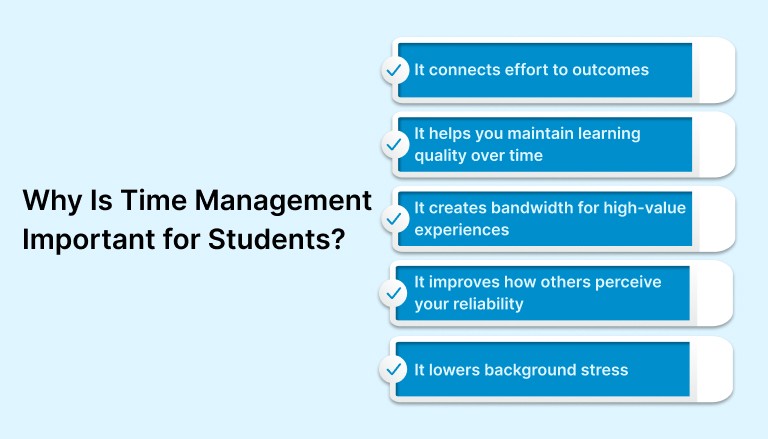
Here are five deeper reasons why it matters:
1. It connects effort to outcomes
Many students put in hours of work but do not see results because their time is spent reacting to immediate tasks instead of moving through a clear plan. Time management helps translate effort into meaningful progress by aligning daily actions with academic goals.
2. It helps you maintain learning quality over time
Cramming and last-minute study sessions might get you through an exam, but they rarely lead to long-term understanding. Spreading tasks over time allows for review, reflection, and deeper thinking, which improves both retention and performance.
3. It creates bandwidth for high-value experiences
Students who manage their time can say yes to more than just classroom work. Whether it is taking on a research assistant role, starting a side project, or applying for competitive programs, time management makes space for growth without sacrificing academic stability.
4. It improves how others perceive your reliability
In group projects, internships, and student leadership, consistency builds trust. Time management supports that consistency by helping you meet deadlines, communicate clearly, and stay prepared for responsibilities others depend on.
5. It lowers background stress
When your week is unplanned, even small tasks create friction. You might forget what is due, double-book yourself, or waste energy switching between activities. A structured schedule removes that uncertainty, giving each day more stability and fewer surprises.
Must read: Time Management Plan: 6 Strategies To Improve Productivity
Common Time Management Mistakes Students Make
Most students are not careless with their time. The issue is usually structural. Certain habits and assumptions quietly make time harder to manage, even when students feel busy all day.
Here are the most common mistakes that create long-term friction.
1. Confusing task awareness with time control
Many students know what they need to do but not when they will do it. Tasks live in lists, messages, or notes, disconnected from actual time. This creates the illusion of organization while deadlines continue to approach unchecked.
The result is constant mental load and repeated re-planning, rather than steady execution.
2. Planning as if energy never changes
Students often assume their focus and motivation will stay consistent throughout the day. Schedules are built around availability, not mental capacity. This leads to important work being placed in low-energy windows, where it gets delayed or rushed.
Over time, this pattern trains students to associate planning with disappointment rather than clarity.
3. Fragmenting responsibilities across too many places
Assignments, reminders, and commitments are often scattered across email, learning platforms, chat apps, notebooks, and memory. When information is spread out, priorities become unclear and tasks slip through unnoticed.
The problem is not a lack of tools, but a lack of a single source of truth.
4. Letting urgency decide the day
When time feels tight, students default to whatever feels most pressing. Emails, messages, and short deadlines take over. Without time set aside for research, drafting, and revision, assignments can turn into last-minute rushes. Important but less urgent work gets postponed repeatedly, even when it has a bigger impact on outcomes.
This creates a cycle where students are always busy but rarely ahead.
5. Leaving no room for uninterrupted thinking
Many schedules are filled with small blocks that look productive on paper but leave no space for sustained concentration. Reading, writing, and problem-solving suffer because they are forced into fragmented time.
This makes complex work feel harder than it actually is and increases avoidance.
6. Abandoning planning during overload
When everything feels behind, planning is often the first thing students drop. It feels like a luxury when pressure is high. In reality, this is when lack of structure causes the most damage.
Without a plan, students rely on memory and urgency, which increases stress and errors.
Also read: Top Time Management Tools to Stay Focused and Get More Done
Best Time Management Tips for Students
Time management improves when students stop trying to control every hour and start building systems that reduce guesswork. These tips are not about working more. They are about creating better conditions for focused effort, smoother execution, and fewer surprises.
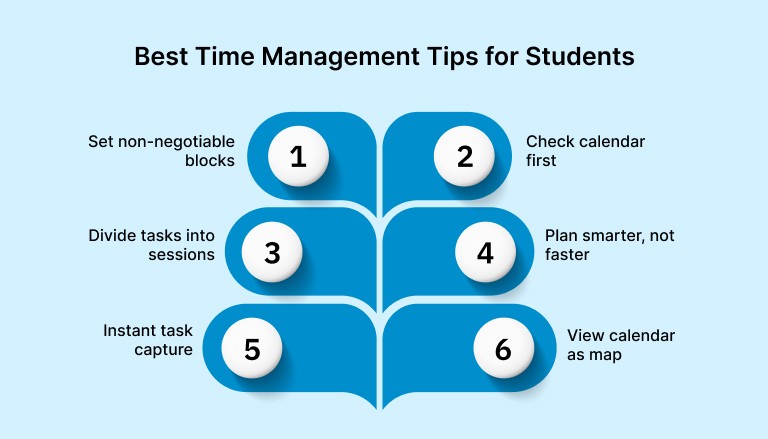
Each of the strategies below addresses a common pain point in student life, from unclear priorities to fragmented focus.
Anchor your week with non-negotiable time blocks
Pick two or three consistent blocks in your week that are fully reserved for focused academic work. These are not optional, and they are not for multitasking. Even if the rest of your schedule shifts, these blocks remain fixed. Over time, they become anchors that give your week structure and help you move through larger assignments without last-minute panic.
Review your calendar before you add new commitments
Students often say yes before seeing what they are already committed to. This leads to double-booking, forgotten tasks, or overly compressed schedules. Before accepting a meeting, group project session, or new deadline, open your calendar and check how much space you truly have. If it looks crowded, delay or renegotiate rather than stack more on top.
Break your largest tasks into named sessions
Instead of writing “finish essay” or “study for exam,” break that task into three or four smaller blocks with clear labels. For example: “outline essay,” “draft intro and first section,” “revise and proof.” Each becomes its own calendar item or to-do. This removes ambiguity and makes it easier to start.
Use past weeks to plan smarter, not just faster
After a busy week, take five minutes to look at what actually happened. What tasks took longer than expected? What time of day felt most focused? Where did things fall through? These patterns can guide how you plan the next week. Improvement comes from adjusting your process, not just repeating it more efficiently.
Build a system for capturing tasks immediately
Most students lose time not because they forget work, but because they remember it too late. Create one reliable place to capture every assignment, deadline, errand, and personal task as soon as it enters your mind or inbox. That system could be digital or analog, but it must be trusted. The more friction you remove from task capture, the less you will rely on memory under pressure.
Treat your calendar as a visual workload map
Your calendar is not just a list of meetings and classes. It shows you your mental and physical capacity. When it looks overloaded, your brain is overloaded. When it is empty, you are flying blind. Use your calendar to see when you are under pressure before you feel it, so you can adjust before the week breaks down.
Must read: Time Blocking for Students: A Simple Guide
Best Time Management Tools for Students
Most students already use several apps to keep track of their time, classes, or tasks. The challenge is not finding a tool. The challenge is trusting one system enough to stick with it. A strong time management tool should give you visibility, reduce the number of decisions you make each day, and help you stay consistent even when your schedule changes.
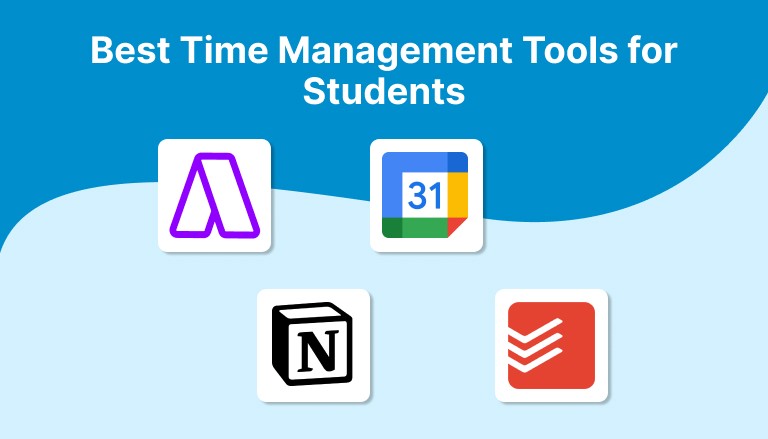
Below are some tools that support serious planning, not just tracking.
Akiflow: Combine tasks and time in one view
Akiflow gives you one place to manage both your calendar and your tasks. Instead of checking your to-do list in one app and switching to a calendar in another, you can plan directly on your timeline. You can also pull in tasks automatically from platforms you already use, like Gmail, Slack, Notion, or Asana.
This makes it easier to turn scattered reminders into a realistic plan for the day or week.
Why students use it:
Easy task capture without interrupting flow
Calendar-based planning for better time awareness
Quick drag-and-drop rescheduling
Task imports from multiple tools in real time
Akiflow is especially helpful for students balancing school with freelance work, research, internships, or side projects. It replaces the need to manage multiple tools at once and helps you focus on what needs to happen next.
Google Calendar: A reliable foundation for structure
Google Calendar is still one of the most dependable tools for managing time. It is simple to use and works across devices. For students, it works best when you move beyond using it just for class schedules. Creating event blocks for study sessions, project work, or personal time helps turn your calendar into a reflection of how you want to spend your time, not just a list of obligations.
It pairs well with other tools but needs manual effort to stay organized.
Notion: Good for managing content, not time
Notion is great for building class dashboards, keeping research notes, or tracking long-term goals. It gives you a flexible space to organize your academic and creative work. Where it falls short is in time management. It lacks built-in features for time blocking, scheduling, or visualizing workload by day.
Students who use Notion often need to rely on a separate tool to handle time-based planning.
Todoist and similar task apps: Simple but limited
Apps like Todoist or Things are fast and lightweight. They help you quickly write down tasks, group them into categories, and set reminders. These tools work well for personal errands or daily routines, but they do not offer scheduling features that connect your task list with available time.
This leads to a common problem: long lists with no plan for when things will get done.
What matters most in a time management tool
It should let you see your time and your tasks together
It should make it easy to adjust your plan as your week evolves
It should reduce context switching instead of adding more tabs
It should work with how you already think, not force a new method
You do not need the most powerful tool. You need the one that helps you think clearly, plan realistically, and focus on the work that matters.
Final Thoughts
Most students are not struggling because they are disorganized. They are struggling because their systems do not match the complexity of their lives. Between academic deadlines, side projects, internships, and everything else, guessing your way through the week is no longer sustainable.
The students who stay consistent, calm, and ahead of their work are not always working harder. They are working from a plan they can trust. Time management helps turn scattered effort into focused progress, and it gives you room to handle your responsibilities without constant stress.
You do not need to plan every minute. You do need a way to see what matters, when to do it, and how much time it really takes.
Plan smarter with Akiflow
Akiflow gives you one place to manage your tasks and calendar, so you can stop jumping between apps and start planning with clarity. It’s built for students who want more control and less chaos. Try Akiflow for free!
FAQs
Q: Why is time management important in student life?
A: Time management helps students handle academic, personal, and extracurricular responsibilities without feeling overwhelmed. It creates structure, reduces stress, and allows for more consistent learning and rest.
Q: What are 10 benefits of time management?
A: Time management helps improve focus, reduce stress, meet deadlines, boost productivity, maintain balance, support long-term learning, build self-discipline, improve decision-making, free up time for personal goals, and develop habits useful beyond school.
Q: Why is time management very necessary?
A: Without time management, students often feel scattered and behind. Planning your time makes it easier to stay on track, work with purpose, and avoid last-minute pressure.
Q: Why is time management important for students presentation?
A: Time management is key to preparing and practicing presentations calmly and effectively. It gives students the space to research, build confidence, and avoid rushed, underprepared delivery.
Q: What is time management in simple words for students?
A: Time management means planning when to do what, so you stay in control of your tasks. It helps students stay organized, meet deadlines, and still have time for rest and hobbies.


