Reviewed October 17, 2026. Published by Akiflow. This comparison is based on the official documentation linked below, not a hands-on benchmark or an independent review.
Apple Watch and iCloud comparison
| Feature | Akiflow | Things 3 |
|---|---|---|
| Apple Watch | Native capture and completion | Native Watch app |
| iCloud Calendar | Direct two-way event connection | Apple Calendar event display |
Things has a native Watch app with task capture, completion, rescheduling and complications. Calendar events shown in Things on other devices are not shown in the Watch app. Things displays events from Apple Calendar in Today and Upcoming. Its documentation distinguishes that display from calendar synchronization or exporting Things tasks into Apple Calendar.
Reviewed October 17, 2026. Native Watch apps, mirrored notifications, task-data sync and calendar subscriptions are different capabilities. Unconfirmed means the reviewed sources do not establish support, not that the feature is necessarily unavailable.
Official evidence: Things 3 source 1; Things 3 source 2. Akiflow Watch documentation; Akiflow iCloud documentation.
The difference that matters
A task list answers what needs doing. A time-blocked calendar also asks whether it fits today. Things can be an excellent home for personal commitments without making every task a calendar event. Akiflow is useful when the gap between the list and available time has become the main source of missed commitments.
What this looks like in a real workday
Suppose you have a proposal, errands and three meetings. In Things, the Today list helps you collect the tasks you intend to do. In Akiflow, assigning time to the proposal makes the capacity problem visible before you promise the afternoon to something else.
Where the trade-offs are
Do not treat time blocking as mandatory. If maintaining calendar blocks feels like administration and your task list already works, switching may add effort. Conversely, seeing events beside tasks does not itself reserve time for the tasks.
Apple Calendar and Apple Watch
Things 3: calendar support
Things displays events from Apple Calendar in Today and Upcoming. Its documentation distinguishes that display from calendar synchronization or exporting Things tasks into Apple Calendar.
Things 3: Apple Watch
Things has a native Watch app with task capture, completion, rescheduling and complications. Calendar events shown in Things on other devices are not shown in the Watch app.
Akiflow: iCloud events and wrist-based capture
Akiflow connects directly to iCloud Calendar. Event changes can sync in both directions, subject to calendar permissions. Scheduling a task does not automatically export it: use Lock to publish a task or Time Slot to an editable calendar. Calendar updates are periodic, not an instant-sync guarantee.
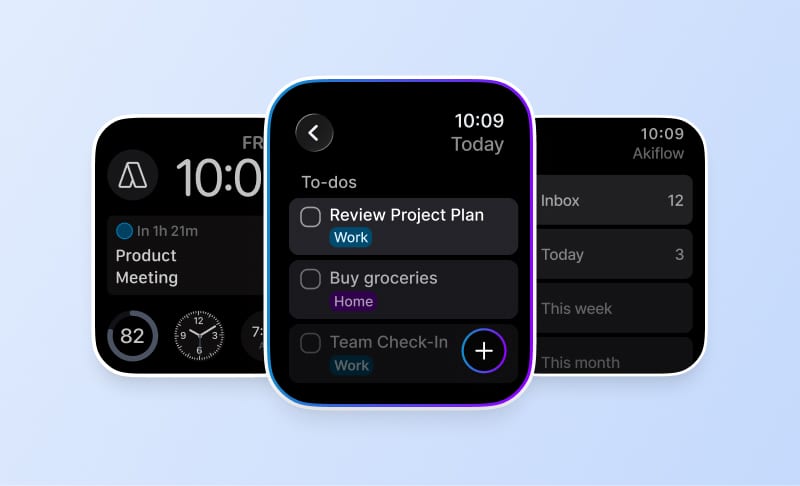
The Apple Watch companion supports task capture by text or dictation, completion and reopening, and views of what is current or next. It requires watchOS 10 or later and a paired iPhone running Akiflow 2.83 or later. It is not a full scheduling editor: Aki, natural-language scheduling, and task editing, rescheduling or deletion are not available on the Watch.
See the iCloud Calendar guide and Apple Watch guide for setup and limits. The Akiflow fall update also covers Travel Time and the desktop redesign.
How to make the decision
Plan a meeting-heavy day in both styles. Compare how easily you notice that the intended tasks exceed the time left, rather than counting how many list features each app offers.
Before changing systems, use a normal busy day rather than an empty demo calendar. Include one changed meeting, one task that takes longer than expected and one new commitment. A useful workflow should make the resulting trade-offs clear without requiring you to maintain conflicting copies of the same work.
Cost and buying considerations
Compare the plan that includes the features you actually need, the billing period, and whether the cost is per person or per workspace. Do not treat a calendar subscription, a native app and a two-way integration as interchangeable paid features.
Check Akiflow’s current pricing before purchasing. This article does not reproduce old promotional prices or unsupported star ratings.
Official sources
Frequently Asked Questions
When might staying with Things be better than adopting time blocking?
If your task list already works and maintaining calendar blocks feels like extra administration, switching may add effort. Things can hold personal commitments without every task becoming an event. Consider calendar-based planning when the gap between your intended tasks and available hours is causing missed commitments, rather than treating time blocking as mandatory.
Does seeing calendar events in Things reserve time for my tasks?
No. Things displays Apple Calendar events in Today and Upcoming, but visibility beside a task list does not itself reserve time for those tasks. For a proposal, errands and three meetings, collecting intentions in Today is different from assigning a work period to the proposal and checking whether enough of the afternoon remains.
Will Things automatically send my tasks to Apple Calendar?
Displaying Apple Calendar events in Things does not automatically export Things tasks as calendar events. The documentation distinguishes calendar display from task export and calendar synchronization. Treat the combined view as a way to see appointments alongside tasks, not as evidence that every task has been published into the original calendar account.
How do the Apple Watch workflows differ?
Things documents task capture, completion, rescheduling and complications, but calendar events displayed on other devices do not appear in its Watch app. Akiflow’s companion supports capture, completion and reopening, with views of current or upcoming work. It is not a full scheduling editor; task editing and rescheduling remain outside the Watch workflow.
How should I compare the two planning styles on a busy day?
Plan a meeting-heavy day in both styles and check how easily you notice that intended tasks exceed the time left. Use the proposal, errands and meetings example to distinguish collecting tasks from assigning work time. The useful comparison is whether a capacity problem becomes visible, not how many list features each product contains.