Reviewed October 17, 2026. Published by Akiflow. This comparison is based on the official documentation linked below, not a hands-on benchmark or an independent review.
Apple Watch and iCloud comparison
| Feature | Akiflow | FlowSavvy |
|---|---|---|
| Apple Watch | Native capture and completion | Not confirmed in reviewed docs |
| iCloud Calendar | Direct two-way event connection | iCloud supported |
The reviewed FlowSavvy platform information identifies web, iOS and Android; it does not establish a native Apple Watch app. FlowSavvy lists iCloud, Google Calendar and Outlook synchronization. iCloud support is therefore not exclusive to Akiflow.
Reviewed October 17, 2026. Native Watch apps, mirrored notifications, task-data sync and calendar subscriptions are different capabilities. Unconfirmed means the reviewed sources do not establish support, not that the feature is necessarily unavailable.
Official evidence: FlowSavvy source 1. Akiflow Watch documentation; Akiflow iCloud documentation.
The difference that matters
Automatic scheduling can reduce the work of arranging tasks, but its usefulness depends on good inputs: durations, deadlines and availability. A task-first planning workflow is useful when deciding what deserves time is as important as finding an open slot.
What this looks like in a real workday
For a predictable set of tasks with clear deadlines, automatic time blocking may be helpful. For a day full of ambiguous requests from different tools, collecting and clarifying the work may matter more than placing it immediately.
Where the trade-offs are
An automatically full calendar is not necessarily a realistic one. Include transition time and check what happens when a task takes longer than expected. Compare the replanning experience under pressure, not only the initial schedule.
Apple Calendar and Apple Watch
FlowSavvy: calendar support
FlowSavvy lists iCloud, Google Calendar and Outlook synchronization. iCloud support is therefore not exclusive to Akiflow.
FlowSavvy: Apple Watch
The reviewed FlowSavvy platform information identifies web, iOS and Android; it does not establish a native Apple Watch app.
Akiflow: iCloud events and wrist-based capture
Akiflow connects directly to iCloud Calendar. Event changes can sync in both directions, subject to calendar permissions. Scheduling a task does not automatically export it: use Lock to publish a task or Time Slot to an editable calendar. Calendar updates are periodic, not an instant-sync guarantee.
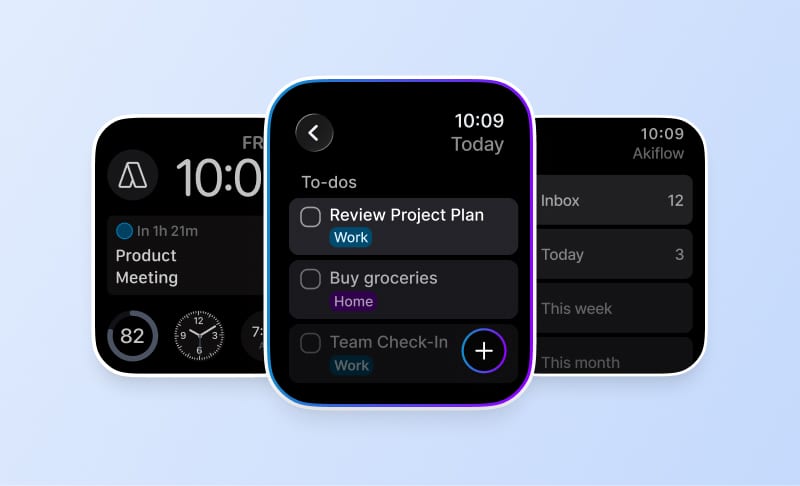
The Apple Watch companion supports task capture by text or dictation, completion and reopening, and views of what is current or next. It requires watchOS 10 or later and a paired iPhone running Akiflow 2.83 or later. It is not a full scheduling editor: Aki, natural-language scheduling, and task editing, rescheduling or deletion are not available on the Watch.
See the iCloud Calendar guide and Apple Watch guide for setup and limits. The Akiflow fall update also covers Travel Time and the desktop redesign.
How to make the decision
Schedule three tasks with different deadlines, then add a meeting and overrun one task. Evaluate whether the resulting adjustments match how you want to work.
Before changing systems, use a normal busy day rather than an empty demo calendar. Include one changed meeting, one task that takes longer than expected and one new commitment. A useful workflow should make the resulting trade-offs clear without requiring you to maintain conflicting copies of the same work.
Cost and buying considerations
Compare the plan that includes the features you actually need, the billing period, and whether the cost is per person or per workspace. Do not treat a calendar subscription, a native app and a two-way integration as interchangeable paid features.
Check Akiflow’s current pricing before purchasing. This article does not reproduce old promotional prices or unsupported star ratings.
Official sources
Frequently Asked Questions
What distinguishes FlowSavvy’s scheduling emphasis from Akiflow’s planning emphasis?
FlowSavvy is worth evaluating when tasks need automatic placement into available calendar time. Akiflow is a candidate when a connected inbox and deliberate daily planning matter more. For clear tasks with deadlines, placement may be the difficulty; for ambiguous requests from several tools, collecting and clarifying the work may come first.
What inputs matter before relying on automatic time blocking?
Useful inputs include durations, deadlines, and availability. They describe how much work there is, when it is needed, and what time is open. Deciding what deserves that time is still a distinct planning question, so evaluate task clarification as well as the convenience of automatic placement.
How can I test whether the resulting schedule is realistic?
Schedule three tasks with different deadlines, then add a meeting and let one task run over. Include transition time and inspect the resulting changes. The test is whether replanning matches how you want to work under pressure, rather than whether the initial calendar looks completely filled.
Does FlowSavvy lack iCloud support compared with Akiflow?
No. FlowSavvy lists iCloud, Google Calendar, and Outlook synchronization, while Akiflow also supports iCloud. Compare scheduling controls and how tasks enter the plan instead of relying on an outdated connectivity gap. A shared calendar provider does not decide which daily planning approach fits your work.
When should I prioritize task intake over immediate scheduling?
When the day starts with ambiguous requests spread across different tools, gathering and clarifying commitments may be more valuable than immediately placing them into free time. A task-first planning workflow addresses what deserves attention as well as when it fits. Compare that need with a predictable set of tasks carrying clear deadlines.