

Playing it safe feels comfortable, but comfort rarely leads to standout results. In a fast-changing world, gradual growth can quietly turn into staying stuck, even when everything seems to be going well. What once felt like progress can slowly become a point where you stop taking the bets that move outcomes.
This is where stretch goals make a difference. They are not just bigger targets but intentional challenges that disrupt routines and sharpen focus. By aiming slightly beyond what feels attainable, you reduce busywork, prioritize meaningful effort, and create space for faster learning and real growth.
This post details a precise framework for setting and sustaining these objectives. You will learn to define outcome metrics, establish guardrails, and use time blocking to bridge the gap between bold vision and daily execution.
Key Takeaways
Promptly addressing workplace conflict prevents productivity losses, morale erosion, and costly employee turnover.
The Thomas-Kilmann model helps leaders select the optimal style for resolving professional disagreements.
Structured conversations and active listening help teams separate objective facts from emotional interpretations.
Predefined decision paths and documented follow-ups ensure that resolutions remain durable and sustainable.
Centralized scheduling tools minimize friction by providing transparency and preventing misaligned team expectations.
What is a Stretch Goal?
A stretch goal is an intentionally ambitious objective that pushes individuals or teams beyond their current performance level. It is designed to drive learning, innovation, and sharper focus rather than incremental improvement.
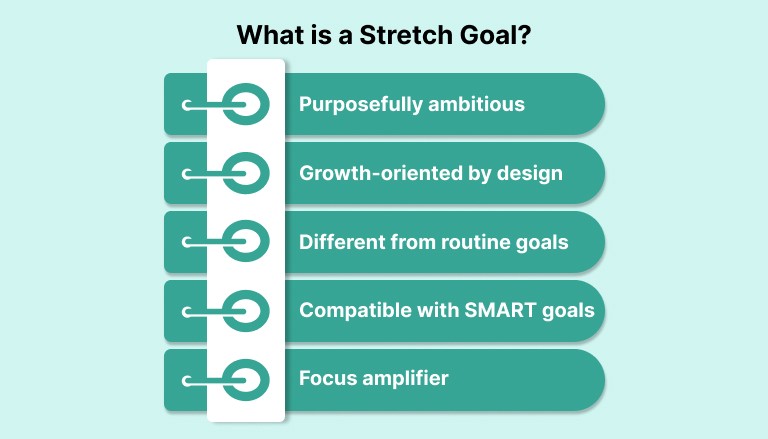
Here is how a stretch goal works in practice:
Purposefully ambitious: A stretch goal sits outside your comfort zone and requires new thinking, skills, or systems to achieve it.
Growth-oriented by design: The primary value is not just hitting the target but accelerating learning, capability building, and strategic clarity along the way.
Different from routine goals: Unlike standard goals that optimize existing performance, stretch goals aim to expand what is possible.
Compatible with SMART goals: Stretch goals define the ambition, while SMART goals help operationalize it through clear metrics, timelines, and execution plans.
Focus amplifier: A well-chosen stretch goal forces ruthless prioritization by making low-impact tasks obvious and nonessential work easier to say no to.
Why Set Stretch Goals Now?
Work today is faster, more complex, and more fragmented than ever. Stretch goals help ambitious professionals cut through the noise, focus on what truly matters, and grow faster by aligning effort with meaningful outcomes rather than busywork.
Here is why stretch goals are especially valuable right now:
Accelerates skill and decision-making growth: Stretch goals push founders and operators to think strategically, experiment quickly, and develop higher-level skills under real constraints.
Forces sharp prioritization: When the target is ambitious, low-impact tasks naturally fall away, making it easier to focus on work that actually moves the needle.
Creates clarity in a limited time: For teams and freelancers juggling multiple responsibilities, stretch goals provide a clear north star that guides daily planning and execution.
Builds momentum and confidence: Making visible progress toward a bold target reinforces belief, energy, and commitment, even before the outcome is reached.
Improves alignment across workstreams: A clear stretch goal helps individuals and teams coordinate efforts, reduce duplicated work, and stay aligned on what success truly looks like.
Also Read: Daily Work Management: Steps to Plan and Control Your Day
A Practical 5-step Framework to Set Stretch Goals
Stretch goals become powerful only when they are designed with structure and intent. This framework helps ambitious professionals translate bold ambition into focused execution, so goals stretch your capability without creating confusion, overload, or burnout.
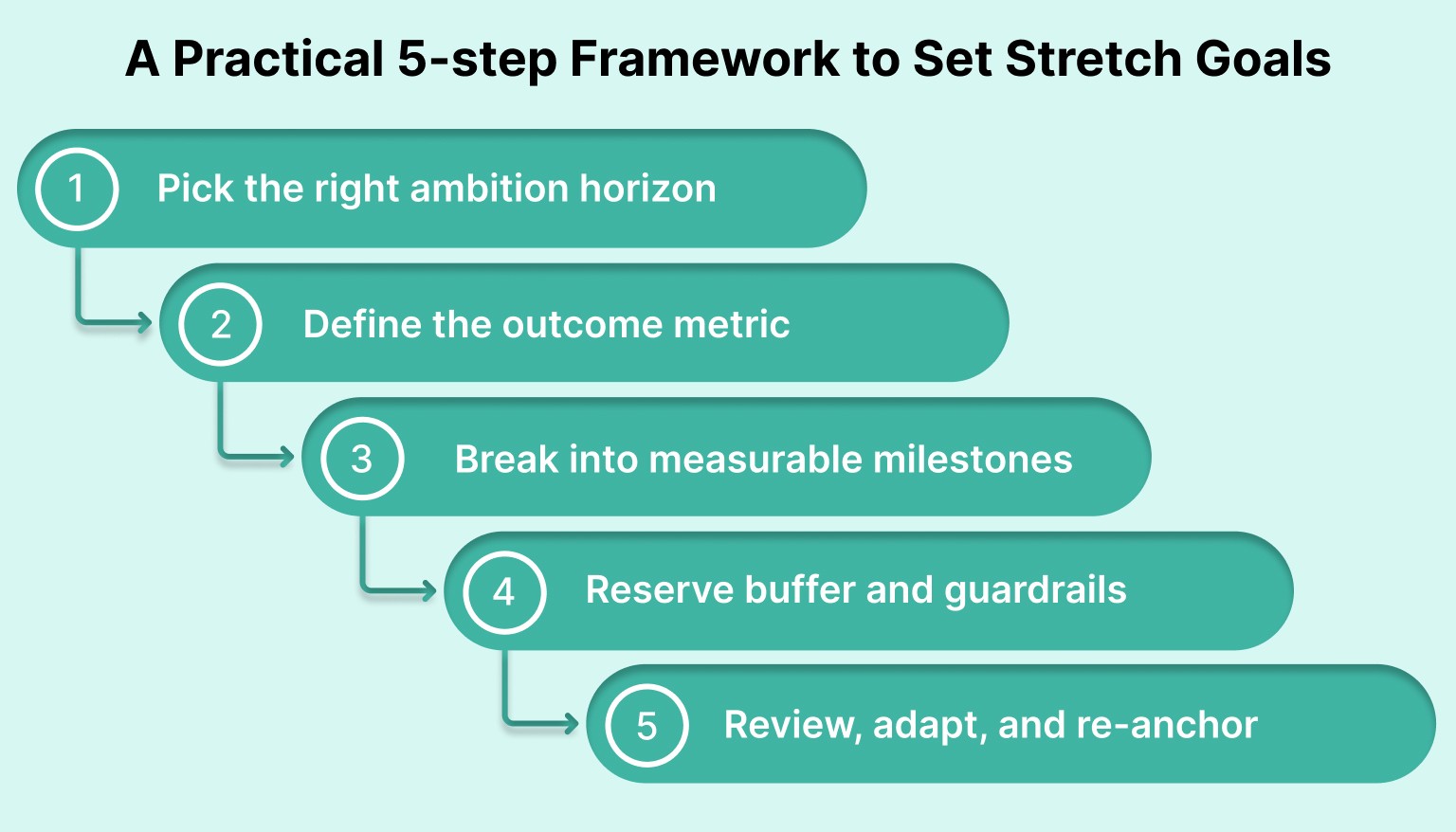
Below is a step-by-step approach you can apply immediately:
Step 1: Pick the right ambition horizon
Set a clear time horizon that balances ambition and urgency, keeping the goal challenging while allowing space for learning and iteration.
Use the following guidelines to define the right horizon:
Choose a 60 to 90-day window
A quarterly horizon is long enough to produce meaningful results and short enough to maintain urgency, visibility, and motivation.Anchor ambition to reality
The goal should feel slightly uncomfortable but not unrealistic. If success feels guaranteed, it is not a stretch.Example in practice
Instead of “grow revenue this year,” aim for “increase monthly recurring revenue by 25 percent in the next 90 days.”
Step 2: Define the outcome metric
Clarify what success looks like by choosing a single outcome metric supported by early indicators to guide daily decision-making.
Use these steps to define the right metric:
Commit to one primary metric
A single outcome metric eliminates ambiguity and prevents effort from spreading across too many priorities.Support with one or two leading indicators
Leading indicators help you track progress early and course-correct before it is too late.Example in practice
Outcome metric could be the number of paid users, while leading indicators might include demos booked or onboarding completions.
Step 3: Break into measurable milestones
Break the stretch goal into smaller milestones so progress feels manageable and execution stays consistent week after week.
Apply the following approach to create milestones:
Translate ambition into weekly targets
Weekly milestones make progress tangible and reduce the psychological weight of a big goal.Convert milestones into daily actions
Each milestone should clearly map to tasks that can be completed within a workday.Example in practice
A goal to launch a new feature might break down into design approval in week one, development completion in week four, and beta release in week eight.
When stretch goals are supported by clear milestones and dedicated time, progress feels easier. Akiflow helps bring tasks and calendars together so important work fits naturally into your week.
Step 4: Reserve buffer and guardrails
Create boundaries that protect quality, energy, and focus while pursuing an ambitious target over a sustained period.
Put these guardrails in place early:
Define what you will not sacrifice
Decide upfront which standards are non-negotiable, such as code quality, customer experience, or personal wellbeing.Protect time and energy
Leave an intentional buffer for unexpected work, decision fatigue, or recovery time to sustain momentum.Example in practice
You may commit to never exceeding a fixed number of weekly work hours while still pushing for an aggressive delivery timeline.
Step 5: Review, adapt, and re-anchor
Review progress regularly and adjust tactics based on real feedback while keeping the original ambition intact.
Use these practices to stay on track:
Schedule weekly reflection sessions
Regular reviews help you identify blockers early and reinforce accountability.Adjust strategy without lowering ambition
If something is not working, change the approach, not the goal itself.Example in practice
If outreach volume is high but conversions are low, refine messaging or targeting instead of abandoning the growth target.
This framework keeps stretch goals challenging but grounded, helping you move from bold intention to consistent execution with clarity and confidence.
Also Read: How to Use Daily Reminders Without Getting Notification Fatigue
Templates and Tools to Plan and Time-block Your Stretch Goal
Stretch goals fail when they stay abstract. Simple templates and the right planning tools help convert ambition into scheduled work, making progress visible and actionable every day without adding complexity to your workflow.
Here is how to turn your stretch goal into a concrete plan:
Use a one-line stretch goal template: Define your objective, a single success metric, a 90-day horizon, weekly milestones, and daily tasks in a single, clear structure.
Translate milestones into scheduled time: Import tasks directly into your calendar so each milestone becomes protected work time rather than a vague intention.
Keep everything in one place: A unified planning tool like Akiflow helps consolidate tasks and calendars, making recurring time blocks easy to maintain and review.
Make progress visually obvious: Use a 90-day template and a sample time-blocked week to quickly spot gaps, overload, or missed priorities.
Review and adjust within the same system
Weekly reviews are more effective when tasks, calendars, and progress metrics live in one place, making it easier to refine plans without friction.
How to Measure Progress Without Losing Focus?
Measuring stretch goal progress should create clarity, not distraction. The right measurement approach keeps attention on what truly matters, prevents overtracking, and supports consistent execution without pulling you into constant analysis or tool switching.
Use the following principles to track progress with minimal friction:
Rely on weekly leading indicators: Track one primary outcome metric supported by a small set of weekly leading indicators that show whether you are moving in the right direction.
Protect a fixed weekly review block: Schedule an uninterrupted 30-minute weekly review to assess progress, identify blockers, and adjust priorities before the next cycle begins.
Use simple visual cues: a progress bar or momentum score that updates with each review makes progress immediately visible and reinforces focus without detailed reporting.
Automate tracking wherever possible: Reduce manual effort by using tools that automatically capture task completion, time allocation, and calendar data.
Separate execution from reflection: Avoid checking metrics during deep work. Keep measurement confined to review sessions, so focus stays on execution.
Execution is where most stretch goals either accelerate or stall, usually at the time-blocking stage. A single system for tasks and calendar can make those milestones stick more naturally. Explore Akiflow for stretch goals.
Five Common Stretch Goal Pitfalls and How to Fix Them
Stretch goals often fail not because they are too ambitious, but because of avoidable execution mistakes. Presenting these pitfalls clearly makes it easier to diagnose issues early and apply focused corrections before momentum is lost.
The table below highlights the most common stretch goal pitfalls and their practical fixes:
Pitfall | Fix |
The goal is too vague or overloaded | Choose one clear outcome metric supported by a single primary leading indicator |
No time blocked for execution | Schedule weekly milestones directly into your calendar and protect those time blocks |
Too many stretch goals at once | Limit focus to one stretch goal per person or team per quarter |
Progress is hard to measure | Convert abstract outcomes into measurable proxies and set up tracking early |
Burnout from overcommitment | Add guardrails, reduce low-impact work, and intentionally schedule recovery time |
How Should Teams Coordinate Stretch Goals?
Stretch goals become far more effective when teams move in alignment rather than in parallel. Clear coordination ensures individual effort supports shared outcomes, reduces friction, and keeps ambitious goals achievable even in fast-moving, distributed teams.
Use the following principles to align stretch goals across a team:
Anchor around one team-level stretch goal: Define a single shared outcome, then support it with one or two clearly scoped individual goals that directly contribute to that target.
Establish lightweight shared rituals: Use a short weekly sync and a visible shared dashboard to maintain clarity, accountability, and momentum without adding meeting overload.
Make dependencies explicit and time-bound: Clearly document cross-team dependencies and assign timelines so handoffs do not silently block progress or stall execution.
Make dependencies explicit and time-bound: Clearly document cross-team or external dependencies and assign timelines so handoffs do not silently block progress.
Decide what you will deprioritize: Identify tasks or commitments that will be paused or reduced, so the stretch goal has real space to succeed.
Also Read: Goal-Setting Frameworks Every Professional Should Know
Quick Checklist to Launch Your First Stretch Goal
Launching a stretch goal does not require complex planning, but it does require intentional setup. This simple checklist helps you move from idea to execution quickly, while ensuring your goal is ambitious, structured, and sustainable from day one.
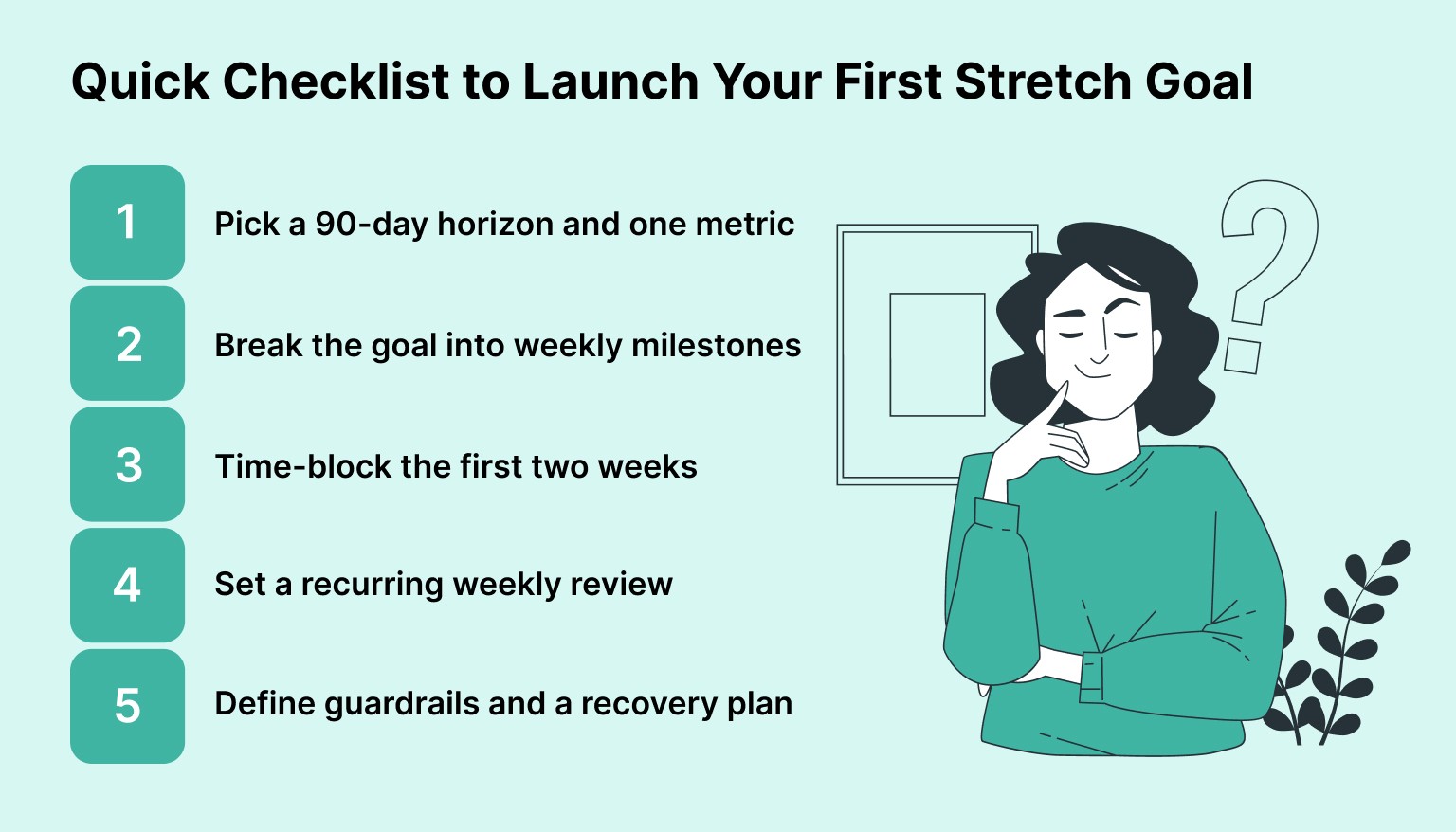
Use this checklist to get your stretch goal off the ground:
Pick a 90-day horizon and one metric: Choose a clear timeframe and a single outcome metric that defines success without ambiguity.
Break the goal into weekly milestones: Translate the ambition into smaller weekly targets that make progress visible and manageable.
Time-block the first two weeks: Schedule concrete work blocks immediately so execution starts before motivation fades.
Set a recurring weekly review: Lock in a fixed review session to track progress, surface blockers, and adjust plans early.
Define guardrails and a recovery plan: Decide in advance how you will protect quality, energy, and focus if pressure increases.
How Tools Can Help You Set Goals?
Setting goals is easier when your tools do the heavy lifting. The right app turns vague intentions into scheduled actions, reduces cognitive load, and keeps momentum visible without adding more meetings or busywork.
Capture and centralize: Save ideas the moment they appear and keep goals, tasks, and reference material in one place so nothing slips between apps.
Break big goals into manageable work: Tools make it simple to decompose outcomes into milestones, weekly targets, and daily actions you can actually schedule.
Turn milestones into calendar commitments: When tasks become protected time on your calendar, they stop being optional and start getting done.
Automate measurement and reminders: Automatic tracking of task completion, time spent, and simple reminders reduces manual busywork and keeps progress transparent.
Reduce context switching: Fewer app jumps mean more sustained focus. A unified workspace helps preserve flow and lowers the startup cost for deep work.
Small changes in how you plan and schedule can have immense effects. Solutions like Akiflow combine tasks and calendar in one interface, so your goals live next to the time you actually have to work on them.
Conclusion
Setting a stretch goal is a deliberate move away from incremental progress toward purposeful growth. Ambitious targets reshape how you think, prioritize, and execute, turning everyday work into focused progress on what truly matters. The real value lies not only in the outcome but in the clarity, discipline, and adaptability developed along the way.
Execution is what sustains that momentum. When clear milestones and protected time support ambitious goals, they become far more achievable. Tools like Akiflow help translate intent into consistent action by keeping priorities, schedules, and progress aligned, so your most important work actually happens.
Frequently Asked Questions
1. How do stretch goals differ from standard performance goals?
Standard goals optimize current performance within existing systems. In contrast, stretch goals require new thinking and radical innovation to achieve results far beyond your comfort zone.
2. Can I set multiple stretch goals simultaneously?
To maintain peak focus, limit yourself to one stretch goal per quarter. Spreading effort across multiple ambitious targets often dilutes impact and leads to fragmentation.
3. Are stretch goals compatible with the SMART goal framework?
Yes. While the stretch goal defines the level of ambition, the SMART framework provides the necessary structure, specific metrics, and timelines to make that ambition actionable.
4. What happens if I fail to reach the target?
The primary value of a stretch goal is the accelerated learning and capability building gained during the pursuit. Use the data to refine your next strategy.
5. How can I pursue ambitious goals without experiencing burnout?
Establish non-negotiable guardrails for well-being and quality from the start. Intentionally schedule recovery time and use time-blocking to ensure your workload remains sustainable and focused.


