
You’re in a team meeting, ideas are flying, but suddenly tensions flare, egos clash, deadlines loom, and what started as a simple disagreement spirals into a full-blown standoff. Sound familiar? Workplace conflicts aren’t just awkward; they’re productivity killers.
In fact, a study by the CPP Global Human Capital Report reveals that U.S. employees spend about 2.8 hours per week dealing with conflict, costing companies a staggering $359 billion annually in lost time.
But here’s the good news: It doesn’t have to be chaos. Mastering effective conflict resolution strategies can turn these friction points into opportunities for stronger teams, better collaboration, and skyrocketing morale. In this blog, we will discuss how you can resolve workplace conflicts effectively.
Key Takeaways
Promptly addressing workplace conflict prevents productivity losses, morale erosion, and costly employee turnover.
The Thomas-Kilmann model helps leaders select the optimal style for resolving professional disagreements.
Structured conversations and active listening help teams separate objective facts from emotional interpretations.
Predefined decision paths and documented follow-ups ensure that resolutions remain durable and sustainable.
Clear scheduling systems minimize friction by providing transparency and reducing misaligned expectations around time and ownership.
Why Quick and Reliable Conflict Resolution Matters?
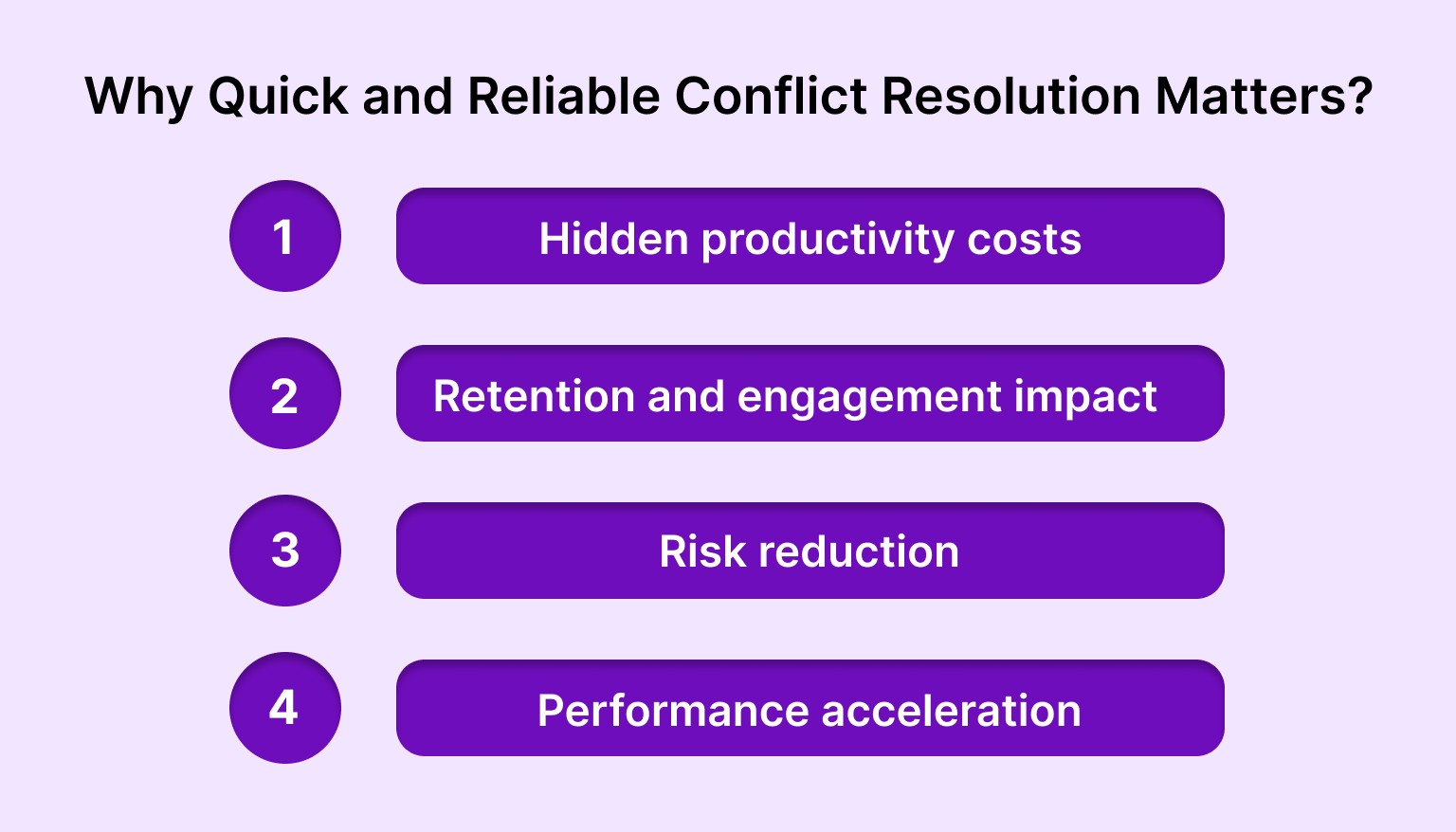
Unresolved conflict quietly drains focus, morale, and momentum across teams. For busy professionals, delays compound fast, turning small disagreements into productivity losses, trust erosion, and avoidable turnover that directly impact business performance.
Here is why addressing conflict early is a measurable advantage, not a soft skill:
Hidden productivity costs: Ongoing conflict reduces focus, increases rework, and consumes leadership time that should be spent on execution and growth, as highlighted in SHRM workplace studies.
Risk reduction: Clear conflict resolution processes lower the likelihood of escalation into formal complaints, legal exposure, or long-term team dysfunction.
Performance acceleration: When conflict is handled quickly, teams make decisions faster, align priorities sooner, and return to high-quality work with less emotional drag.
The Thomas-Kilmann Conflict Mode Instrument (TKI)
The Thomas-Kilmann model explains how people respond to conflict based on assertiveness and cooperation. It outlines five distinct styles, helping individuals and leaders choose the most effective approach for resolving disagreements without harming relationships or outcomes.
The table below summarizes what each style is, when to use it, and how to apply it effectively.
Conflict Style | What it is | When to use | Benefit |
Competing | A direct, assertive approach focused on winning the outcome | When quick decisions are required, such as safety issues, deadlines, or high business risk | Fast resolution and clear authority |
Avoiding | Stepping away from the conflict temporarily or permanently | When the issue is minor, emotions are high, or more information is needed | Saves time and emotional energy |
Accommodating | Prioritizing the relationship over the outcome | When the relationship matters more, or the other side has a stronger position | Builds goodwill and reduces tension |
Compromising | Each side gives up something to reach a middle ground | When time is limited, and a quick, workable solution is needed | Balanced and efficient resolution |
Collaborating | Working together to find a win-win solution | For high-stakes or recurring conflicts where trust matters | Strong solutions and long-term alignment |
Misaligned schedules and overlapping priorities are common triggers for workplace tension. Tools that centralize tasks and calendars into a transparent view help reduce friction caused by double-bookings and missed handovers.
Streamline Your Team’s Coordination with Akiflow.
Five Practical Conflict Resolution Strategies You Can Use Immediately
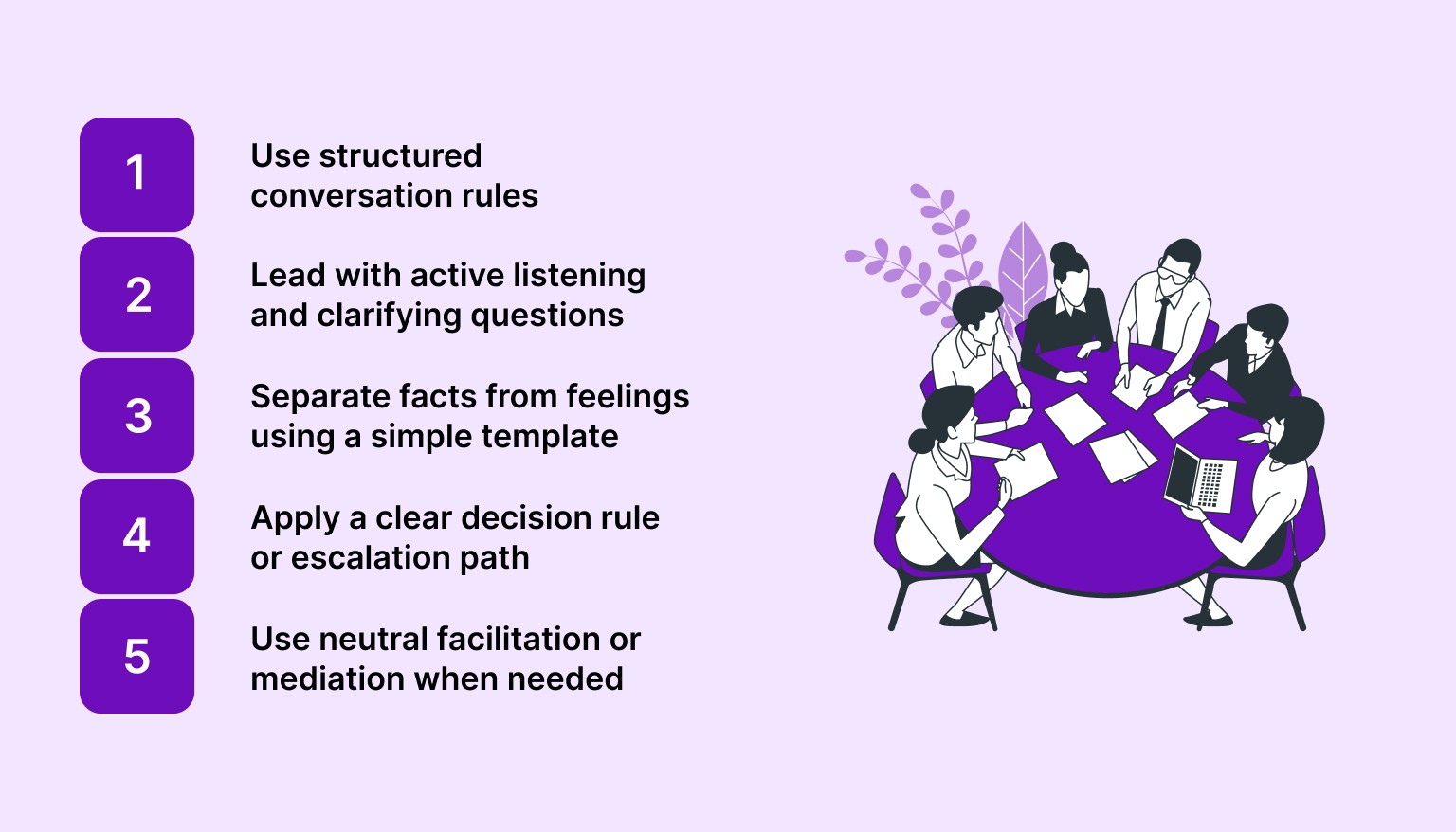
These strategies are designed for fast-moving workplaces where conflict cannot linger. Each one focuses on clarity, structure, and forward motion, helping teams resolve disagreements without draining time, energy, or trust.
Below are five proven approaches, broken into clear actions you can apply the same day.
1. Use structured conversation rules
Clear ground rules prevent emotional drift and keep discussions productive. Time-boxed conversations reduce defensiveness and help teams focus on outcomes instead of blame.
Set a clear intent for the conversation before starting
Ask permission for each person to speak without interruption
Time-box responses and restate the core points before moving forward
Example: Schedule a 20-minute resolve-and-move slot after a sprint planning disagreement
2. Lead with active listening and clarifying questions
Most conflict escalates because people feel unheard, not because they fundamentally disagree. Active listening reduces emotional intensity and helps surface the real issue more quickly.
Paraphrase what the other person said in your own words
Ask one clarifying question to test understanding
Confirm shared understanding before proposing solutions
Example: Restating a teammate’s concern before suggesting an alternative approach
3. Separate facts from feelings using a simple template
Blending emotions with assumptions makes conflict harder to resolve. A simple structure helps teams discuss issues without personal attacks or defensiveness.
State observable facts without interpretation
Describe the impact or feeling caused by those facts
Clearly state the desired outcome or change
Example: When the deadline changed without notice, I felt unprepared. I would like advanced communication next time.
4. Apply a clear decision rule or escalation path
Conflict often stalls when no one knows who has the authority to decide. A predefined decision rule keeps momentum and avoids repeated debates.
Agree on a single decision owner
Define decision criteria in advance
Set a short appeal window if needed
Example: Product lead decides after input from engineering and design
5. Use neutral facilitation or mediation when needed
Some conflicts need an external perspective to move forward. Neutral facilitation prevents power dynamics from derailing resolution.
Pause the discussion before it escalates further
Appoint a neutral facilitator or mediator
Run a structured mediation session with clear outcomes
Example: A manager facilitating a discussion between two senior contributors in conflict
Also Read: The 80:20 Rule: What Does It Mean for Work and Productivity?
Ready-to-Use Conflict Resolution Action Checklist
When conflict surfaces, clarity and speed matter more than perfect wording. This simple checklist gives teams a repeatable way to pause escalation, reach agreement, and ensure follow-through without overthinking the process.
Use the steps below as a copy-paste guide during real workplace conflicts.
Pause the interaction: Stop the discussion briefly to prevent emotional escalation and reset the tone before continuing.
Listen actively: Give the other person space to explain their perspective without interruption or immediate judgment.
Paraphrase for clarity: Restate what you heard in your own words to confirm shared understanding.
Propose one option: Suggest a single, practical path forward instead of multiple competing solutions.
Agree on the next step: Decide what will happen next and what success looks like in concrete terms.
Document the outcome: Write down the decision to avoid future misunderstandings.
Follow up within 48 to 72 hours: Check progress and close the loop to prevent the issue from resurfacing.
Outcome logging template: Record the date, parties involved, agreed action, responsible owner, and follow-up date in a shared document or task system for accountability.
Common Conflict Resolution Pitfalls and How to Fix Them
Even well-intentioned teams struggle with conflict when patterns repeat unchecked. Most failures come from avoidable habits like delay, poor framing, or lack of follow-through. Recognizing these pitfalls early makes resolution faster, calmer, and far more effective.
The table below highlights common mistakes and the simplest corrective action for each.
Pitfall | Fix |
Avoiding the issue until it worsens | Time-box a 30-minute resolution meeting within 48 hours |
Framing the problem as a personal attack | Reframe the discussion using the fact, feeling, desired outcome template |
Letting a single meeting decide everything | Apply a 72-hour cooling-off period, then reconvene with clarity |
No clear owner for the decision | Assign one decision owner with agreed objective criteria |
Skipping follow-up checks | Add a follow-up to the calendar and set a 1:1 reminder |
How to Make Conflict Resolution a Repeatable Habit Across Teams?
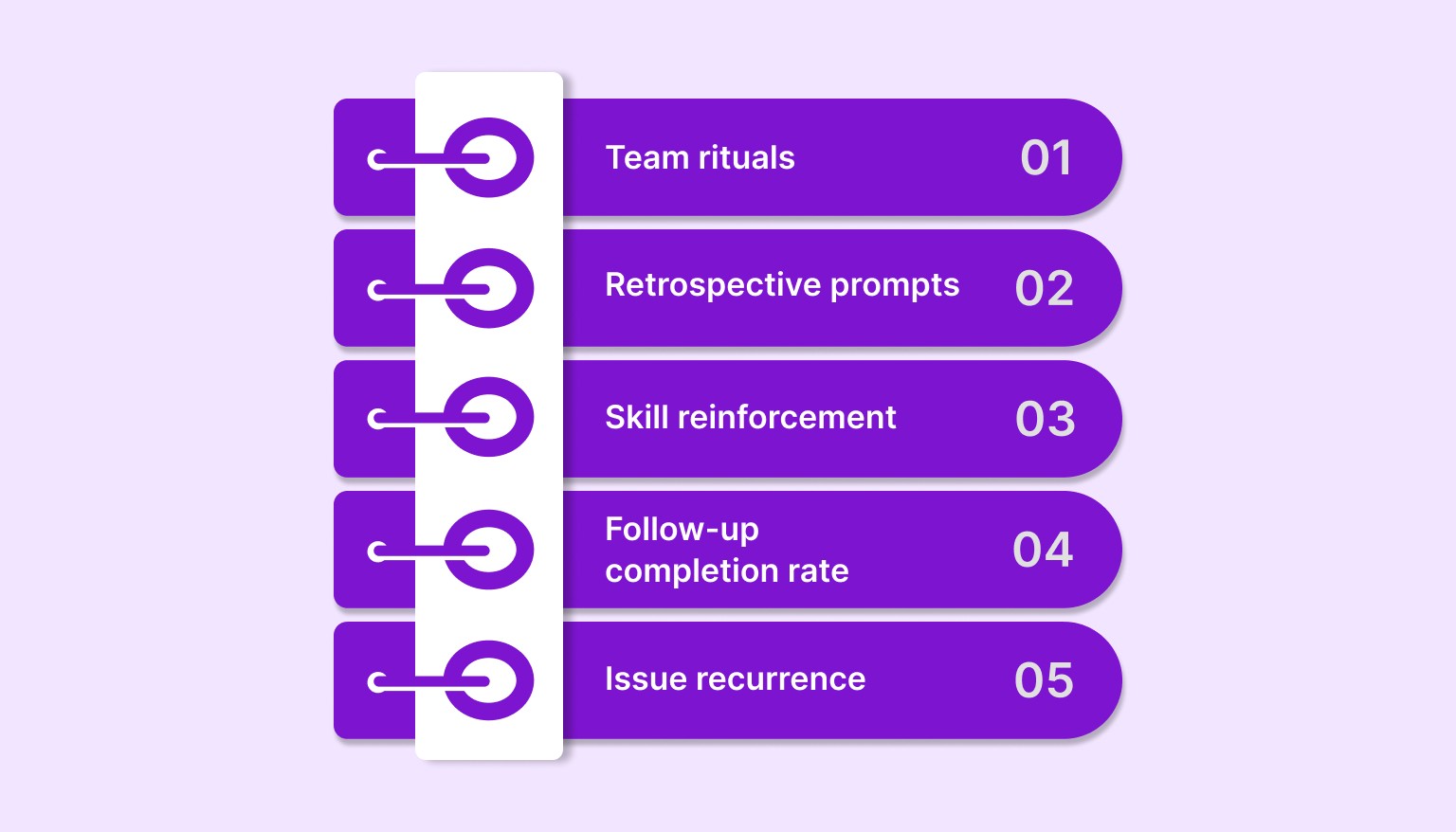
One-off fixes do not scale. Teams resolve conflict consistently only when it is built into routines and measured over time. Simple rituals and clear metrics turn conflict resolution from a reactive skill into a shared operating habit.
Here are practical ways to make conflict resolution repeatable and sustainable across teams.
Team rituals: Introduce a monthly team health check meeting to surface tensions early and normalize open discussion before issues escalate.
Retrospective prompts: Add a standing retrospective question about unresolved disagreements so conflict is reviewed alongside delivery and outcomes.
Skill reinforcement: Provide lightweight training on active listening and constructive feedback to ensure everyone shares the same conflict language.
Follow-up completion rate: Track whether agreed actions are completed after resolution conversations using existing review or planning processes.
Issue recurrence: Monitor how often the same conflict reappears to assess whether resolutions are durable or superficial.
Akiflow’s Role in Effective Workplace Conflict Resolution
Effective conflict resolution in the workplace hinges on clear communication, timely interventions, and tools that prevent escalation by aligning schedules and expectations.
Akiflow supports smoother collaboration by reducing scheduling friction and increasing transparency around tasks and time commitments. This proactive approach allows teams to address issues calmly with real-time visibility, enhancing trust and collaboration without added stress.
Akiflow’s following features prevent and resolve conflicts by enabling seamless coordination and automation:
Calendar conflict visibility: Highlights overlapping events and double-bookings across synced calendars, helping teams adjust schedules before issues arise.
Team Schedule Views: Provides shared visibility into availability and workloads, enabling fair task delegation and reducing arguments over resources or priorities.
Universal Inbox: Centralizes tasks and updates, making responsibilities clearer and reducing miscommunication that can lead to friction.
Conclusion
Conflict resolution is more than a soft skill; it is a vital operational necessity. By adopting structured frameworks and prioritizing clarity, leaders transform potential disruptions into opportunities for innovation. When tension is addressed with speed and precision, teams build a foundation of trust that sustains long-term productivity and high-level execution.
Preventing unnecessary friction requires clear systems around communication, ownership, and time. Akiflow streamlines coordination and enhances transparency, ensuring your team remains perfectly aligned.
Visit Akiflow today to see how integrated task and calendar planning can reduce scheduling friction and support smoother team coordination.
Frequently Asked Questions
1. Why is immediate conflict resolution essential in a professional environment?
Addressing conflict early prevents productivity losses, maintains employee morale, and stops minor disagreements from escalating into costly legal issues or significant team turnover.
2. What is the benefit of using the Thomas-Kilmann model?
This model provides a framework to identify five distinct conflict styles, allowing leaders to choose the most effective approach based on levels of assertiveness and cooperation.
3. How do you separate objective facts from personal emotions during a dispute?
Use a structured template to state observable actions, describe their specific impact, and propose a desired outcome without relying on subjective assumptions or personal attacks.
4. When is it appropriate to involve a neutral third-party facilitator?
Engagement of a mediator is necessary when power dynamics derail progress or when high-stakes conflicts reach a stalemate that internal parties cannot resolve objectively.
5. How can a tool like Akiflow proactively reduce workplace friction?
Akiflow increases transparency by flagging overlaps and centralizing tasks, preventing the logistical misunderstandings and resource competition that frequently trigger professional discord.


