Summary
Akiflow suits people who want to capture tasks quickly from connected work tools and arrange them alongside calendar events. Its command bar and task inbox support that workflow.
Sunsama is worth considering when the daily planning ritual itself is the priority. Compare the guided planning experience with Akiflow using a normal working day, not an empty demo account.
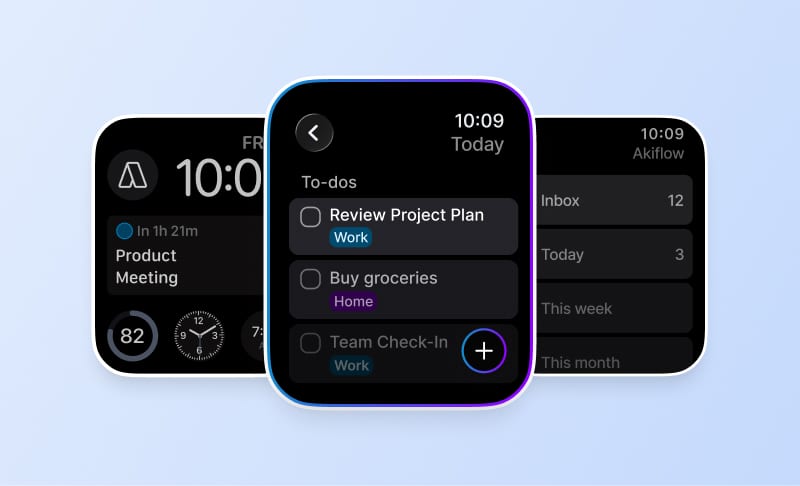
Both support iCloud Calendar. Akiflow adds a dedicated Apple Watch app for task capture and completion; Sunsama’s current App Store listing does not include watchOS.
Akiflow and Sunsama both combine tasks and calendars. Akiflow emphasizes quick capture and daily execution; Sunsama emphasizes guided planning and review. This is not a manual-versus-AI divide: Sunsama now documents Sunny and Autoplan beta as well as MCP. Compare the actual workflow and the status of beta features before choosing.
Apple ecosystem verdict: Both apps support iCloud Calendar. Akiflow’s distinct Apple-device advantage is its Watch companion for capture and task completion; Sunsama’s current App Store listing covers iPhone and iPad, not watchOS.
Apple Watch and iCloud Calendar
Apple feature | Akiflow | Sunsama |
|---|---|---|
Apple Watch | Capture and complete tasks; requires watchOS 10+ and Akiflow 2.83+ on a paired iPhone. | No watchOS app listed in its current App Store compatibility information. |
iCloud Calendar | Direct two-way event sync. Lock tasks or Time Slots to an editable iCloud calendar. | Supports Apple (iCloud) Calendar; this is not exclusive to Akiflow. |
Apple feature information checked on October 14, 2026. Sources: Sunsama source 1; Sunsama source 2. See Akiflow’s iCloud guide and Watch guide for setup and limits.
Akiflow vs Sunsama at a glance
Feature | Akiflow | Sunsama |
|---|---|---|
Individual pricing | US$34 monthly or US$19/month billed yearly | US$22 monthly or US$17/month billed yearly |
Planning approach | Task inbox and visible time blocking | Guided daily planning and review |
Calendar accounts | Google, Outlook/Microsoft 365 and iCloud | Google, Outlook and Apple Calendar |
Assistant features | Aki and supported MCP actions | AI and MCP; Sunny and Autoplan beta |
Task sources | Supported work-tool connectors; behavior varies by integration | Calendar and task-tool integrations |
Main buying question | Do you need one place to collect work and plan it? | Do you want a guided planning ritual? |
Where Sunsama is better
Sunsama’s whole product is a routine, and that is a real advantage if a routine is what you are missing.
The daily ritual is the product, not a feature. Sunsama walks you through planning the day, one task at a time, and asks you to commit to how long each will take. If you are the kind of person who opens a planner and closes it again, that friction is the point and it works.
The weekly review closes the loop. Planning tools are easy; reflecting is not. Sunsama builds the weekly review in, so the week gets looked at rather than just lived.
Calm as a design constraint. Sunsama emphasizes a guided planning experience. Its current offering also includes AI assistance and Autoplan beta, so a calm interface should not be confused with a lack of automation.
A longer trial, and no card. Sunsama gives a 14-day trial with no credit card and unlimited access to all features. Akiflow’s trial is 7 days and requires a card. That is a real difference in how much you risk to find out. Two weeks is also enough to sit through two weekly reviews; one week is not.
Cheaper on both cycles.Sunsama currently advertises US$22 monthly or US$17 per month billed yearly. Akiflow advertises US$34 monthly or US$19 per month billed yearly. Sunsama is lower-priced on these individual plans; choose Akiflow for a better-fitting workflow, not a price advantage.
If you tried Akiflow and bounced off it because it felt like a cockpit, Sunsama is a fair answer and we would rather say so here than have you find out after paying.
Where Akiflow is better
Capture breadth. Akiflow pulls tasks from Slack, Gmail, Notion, Todoist, Asana, ClickUp, Jira, Linear, Trello, GitHub, Google Calendar, Outlook and Microsoft 365, Teams, Zoom and Zapier/IFTTT into a single inbox, with synchronization behavior depending on the connector. If your work arrives in five places, this is the difference between a planner and another list.
Speed. The command bar means capturing, scheduling and rescheduling happen without leaving the keyboard. Guided rituals are good at making you plan; a command bar is good at letting you replan at 3pm when the day breaks.
Agents can drive it. Akiflow runs a hosted MCP server at mcp.akiflow.com/mcp with supported task, calendar and Time Slot actions. Claude, ChatGPT, Cursor, Codex or any MCP client can read and change your plan. It is included in Pro, not sold as an add-on.
Aki. An AI assistant inside the app, also reachable by email and WhatsApp, that transcribes and summarises meetings.
Scheduling extras in one subscription. Availability sharing provides booking links. Time Slots group planned work; they are not the name of the booking-link feature. Check the current plan for included planning and assistant capabilities.
Platforms. Web, macOS and Windows desktop apps, iOS and Android.
Where Akiflow is honestly weaker: there is no free plan, the trial is 7 days and asks for a card, and the app does not push you into a ritual the way Sunsama does. If self-discipline is the gap, software that waits for your input will not close it.
Verdict
Verdict. Choose Sunsama if your problem is that you do not plan: its guided daily ritual and weekly review are the product, and no amount of shortcuts substitutes for that. Choose Akiflow if your problem is that you plan constantly and the plan keeps breaking: it consolidates tasks from fifteen tools into one inbox, lets you rebuild the day from the keyboard in seconds, and exposes the whole plan to Claude or ChatGPT through its MCP server. Akiflow is $19 per month billed yearly or $34 monthly with a 7-day trial that requires a card and no free plan; Sunsama is $22 monthly or $17 billed yearly with a 14-day trial and no card, which makes it the cheaper subscription on both cycles. Neither has a free plan. They are not close substitutes, and the cheaper one is not the answer to which is better.
Other Sunsama alternatives
Motion is strongest for automatic scheduling. Reclaim is best for defending focus time and habits. Morgen is a strong calendar-first option for people managing several accounts. Todoist is best for people who want a focused task list before a full daily planning system.
Switching from Sunsama to Akiflow
Start the 7-day trial. A card is required and there is no free plan. Set a reminder for day 6 so the renewal is a decision, not a surprise.
Connect your calendars first, before any task tool. Google Calendar, Outlook or Microsoft 365. If the calendar is wrong, nothing else matters.
Connect the tools your tasks actually live in. Connect the task sources you actually use. Verify each connector's import, completion and update behavior; not every source field is synchronized in both directions.
Rebuild your ritual. Turn on the daily and weekly rituals so you keep the habit Sunsama gave you. This is the step most switchers skip and then miss.
Run both for one week. Plan tomorrow in Akiflow tonight, keep Sunsama open, and compare at the end of the week. Cancel the one you did not open. Keep the Sunsama subscription until you are sure.
Frequently asked questions
How do Sunsama and Akiflow compare for Apple Watch and iCloud?
Yes, both support iCloud Calendar. Choose Akiflow if capturing and completing tasks from its dedicated Apple Watch app is important to your routine. Sunsama’s current App Store listing does not list watchOS support; mirrored phone notifications are not the same as a Watch app.
Is Akiflow cheaper than Sunsama?
Sunsama currently advertises US$22 monthly or US$17 per month billed yearly. Akiflow advertises US$34 monthly or US$19 per month billed yearly. Sunsama is lower-priced on these individual plans; choose Akiflow for a better-fitting workflow, not a price advantage.
Is Akiflow free?
No. There is no free plan. Akiflow has one plan, Pro, at $34 per month billed monthly or $19 per month billed yearly, and a 7-day free trial that requires a card. Older pricing pages are out of date. Students and researchers can ask for a discount.
Does Akiflow have a daily planning ritual like Sunsama?
Yes, Akiflow has daily and weekly rituals, plus a Daily Dashboard and a Schedule Optimizer. They are lighter than Sunsama’s guided flow: Akiflow prompts and assists, Sunsama walks you through it question by question. If the guidance itself is what you are buying, Sunsama does it more thoroughly.
Does Akiflow work with Claude or ChatGPT?
Yes. Akiflow runs a hosted MCP server at mcp.akiflow.com/mcp with supported task, calendar and Time Slot actions. It works with Claude, ChatGPT, Cursor, Codex and any MCP client, and it is included in the Pro plan. Akiflow also has Aki, its own in-app AI assistant.
Can I use Sunsama and Akiflow together?
You can, but you probably should not pay for both past a trial. They occupy the same slot in the day. If you want to try it, run both for one week on the same real workload, plan tomorrow in each tonight, and cancel the one you stop opening.
October 2026 fact-check notes
Reviewed October 17, 2026 against official documentation. This is an Akiflow-published editorial comparison, not an independent hands-on benchmark. Prices are plan- and billing-specific; beta features should not be assumed available in every account.
Akiflow's Watch companion supports capture, completion and current/up-next information, not task editing or rescheduling. It requires watchOS 10+ and a paired iPhone running Akiflow 2.83+. Its iCloud connection handles events, not Apple Reminders. Lock a task or Time Slot to publish it to an editable calendar; merely scheduling it does not export it. Sync is periodic, and calendar permissions still apply.
Setup and limitations: Akiflow Apple Watch guide; Akiflow iCloud Calendar guide.
Explore Akiflow for Apple Watch and the iCloud Calendar integration for setup, supported features and FAQs.