
Life rarely feels disorganized because of a lack of effort. More often, it feels chaotic because there is no clear system holding everything together. Tasks live in one place, reminders in another, and time itself feels disconnected from priorities.
Most people try to fix this by adding more tools or longer task lists. That usually makes things worse. Without structure, information spreads, decisions slow down, and important work keeps getting postponed.
This guide explains how to build systems to organize your life that actually work day to day. You will learn how to connect tasks to time, reduce mental clutter, and create routines that support consistency without rigidity.
Key Takeaways
Willpower is unreliable; systems are not. A sustainable life organization depends on reducing daily decisions, not increasing discipline or motivation.
Tasks without time are just intentions. Any system that does not connect tasks to your calendar will eventually lead to delays, reactive days, and slow progress.
Clarity beats perfection. The most effective systems to organize your life focus on visibility and prioritization, not rigid structure or detailed categorization.
Execution matters more than planning. Planning should be time-bound and lightweight, with the majority of effort reserved for scheduled, focused work.
Simple rhythms sustain momentum. Weekly reviews, daily anchors, and consolidated systems create consistency that holds up even during busy or unpredictable weeks.
Why Life Organization Needs Systems, Not Willpower?
Motivation comes and goes. Systems stay.
When an organization relies solely on discipline, it breaks down under pressure. Busy weeks, unexpected requests, and decision fatigue quickly derail even the best intentions. A reliable system removes the need to constantly decide what to do next.
Effective systems to organize your life share three qualities:
They reduce decision-making
They make priorities visible
They fit into real schedules, not ideal ones
Instead of relying on memory or constant effort, a system quietly guides daily actions.
The Core Problem: Tasks Without Time
Most people manage life with lists. Work tasks, personal errands, long-term goals, all written down somewhere. The issue is not the list itself. The issue is that lists do not account for time.
Time is a finite resource. While a task list reflects your intentions, a calendar shows what is realistically possible.
When tasks are not connected to time, three things happen:
Important work keeps getting delayed
Days fill up with reactive tasks
Progress feels slow despite being busy
Any system that ignores time will eventually collapse under its own weight.
What Life Organization Systems Should Actually Do?
Good organization systems are not about perfection. They are about clarity.
At a minimum, systems to organize your life should help you:
See everything you are responsible for in one place
Decide what matters this week, not someday
Protect time for important work
Review and adjust without friction
If a system adds more maintenance than it provides in value, it will not last.
Must read: 10 Strategies for Mastering Time Management
A Practical Framework for Organizing Your Life
Instead of collecting scattered tips, it helps to follow a simple structure. This framework focuses on making life organization sustainable.
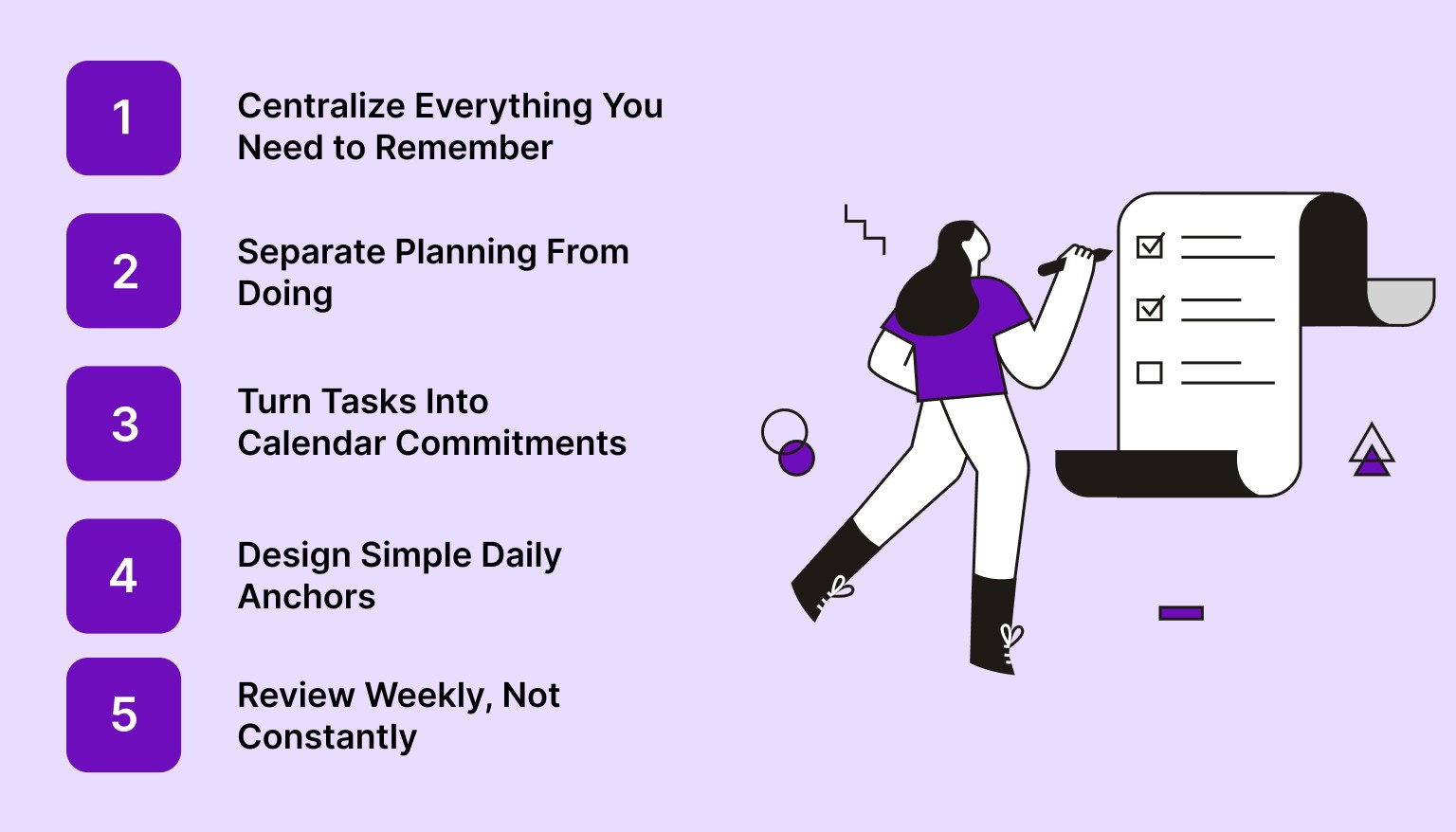
1. Centralize Everything You Need to Remember
Fragmentation is the fastest way to feel overwhelmed. Tasks in one app, notes in another, and reminders somewhere else create constant mental switching.
Start by capturing everything in one system:
Work tasks
Personal responsibilities
Ideas and follow-ups
Recurring commitments
This reduces the background anxiety of wondering what you might be forgetting.
A single capture point is the foundation of effective systems to organize your life.
2. Separate Planning From Doing
Many people try to plan while they are already overwhelmed. That rarely works.
Instead:
Reserve a short daily or weekly planning window
Decide priorities when your mind is clear
Use the rest of the day for execution
This separation prevents constant replanning and reduces distraction.
3. Turn Tasks Into Calendar Commitments
Tasks become real only when they are scheduled.
Rather than hoping to “find time,” assign work to actual calendar slots. This forces honest decisions about what fits and what does not.
Benefits of scheduling tasks:
Clear limits on daily workload
Fewer last-minute decisions
Better follow-through on important work
Time blocking supports consistency by reserving specific blocks of time on your calendar for focused work, routines, or responsibilities.
This step is where most systems to organize your life either succeed or fail.
4. Design Simple Daily Anchors
Daily routines reduce friction. They remove the need to decide when to start or stop certain activities.
Examples of anchors:
A fixed start-of-day planning block
A recurring focus block for deep work
A short end-of-day review
These anchors stabilize your schedule even when the day itself changes.
5. Review Weekly, Not Constantly
Overtracking creates fatigue. Undertracking leads to drift.
A short weekly review is enough to:
Check what moved forward
Identify what slipped
Adjust priorities for the next week
Keep the review simple. The goal is clarity, not analysis.
Strong systems to organize your life rely on rhythm, not constant monitoring.
Common Life Organization Mistakes to Avoid
Even well-designed life organization systems can break down when small, repeated mistakes go unnoticed. These issues rarely come from laziness or lack of effort. They usually stem from systems that look good on paper but do not match how people actually work day to day.
Avoiding these common mistakes will help your systems to organize your life and stay usable under pressure, not just during calm weeks.
Each issue below weakens execution in a different way, but all of them are fixable with small structural changes.
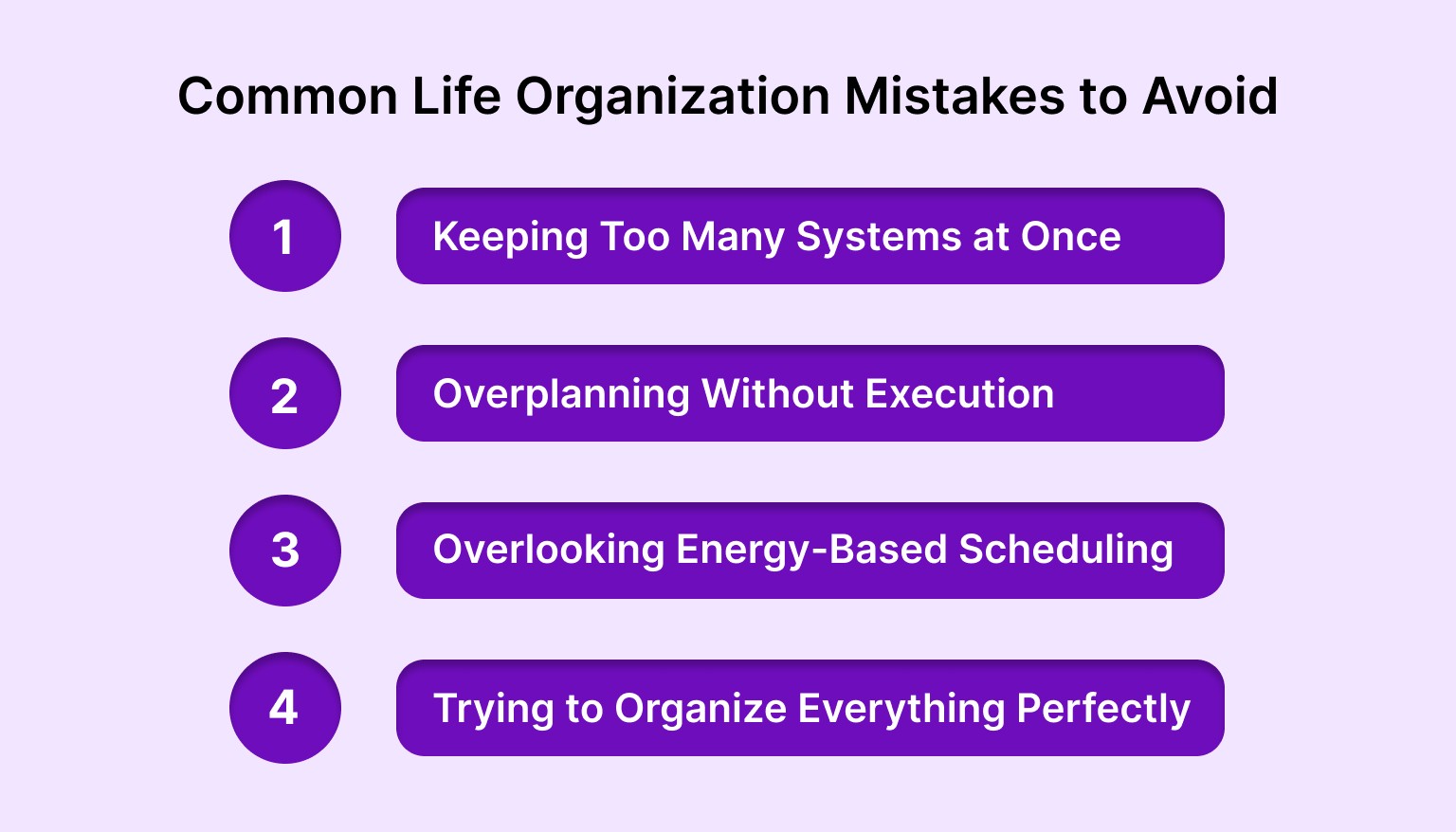
1. Keeping Too Many Systems at Once
Using multiple planners, apps, notebooks, and reminder tools fragments attention. Instead of feeling organized, you spend time deciding where something belongs or worrying about what you might be missing.
When tasks are spread across systems:
Priorities become unclear
Follow-ups slip through the cracks
Planning takes longer than necessary
Effective systems to organize your life rely on consolidation. One reliable system that you check daily will outperform several tools used inconsistently. Clarity comes from fewer moving parts, not more features.
2. Overplanning Without Execution
Planning feels productive, but it is not the same as progress. When plans become overly detailed or are constantly revised, execution slows.
This mistake shows up when:
Plans are rewritten multiple times a week
Tasks stay in planning mode without being scheduled
You feel busy organizing, but see little forward movement
A functional system limits planning time and prioritizes action. Planning should support doing, not replace it. If a system requires frequent reworking, it needs simplification.
3. Ignoring Energy Levels When Scheduling Work
Not all hours are equal. Treating them that way leads to frustration and incomplete work.
Scheduling demanding tasks during low-energy periods often results in:
Delays and procrastination
Lower quality output
Longer workdays with less impact
4. Trying to Organize Everything Perfectly
Perfectionism quietly undermines many organizational systems. The desire to categorize, label, and structure every detail adds unnecessary complexity.
This usually leads to:
Overly rigid systems
High maintenance overhead
Frustration when plans change
Life is unpredictable. Systems should absorb change, not break under it. The goal is progress and reliability, not perfect structure. Flexible systems to organize your life are easier to maintain and far more resilient.
Also read: Time Management Plan: 6 Strategies To Improve Productivity
How Can Tools Support Life Organization?
Tools should reduce effort, not add complexity. When they are chosen and used well, they support systems that organize your life, making everyday planning easier and more consistent.
The right tool helps you handle the basics without friction:
Capture tasks quickly so ideas, requests, and follow-ups do not stay in your head or get lost
See priorities clearly without sorting through long, outdated task lists
Connect tasks to available time so plans reflect what is realistically possible
Review progress easily without manual tracking or constant reorganization
When tasks and time live in separate tools, planning becomes fragmented. You may know what needs to be done, but not when it will happen. Using a system that keeps tasks and your calendar in one place helps close that gap.
Akiflow supports this approach by letting you capture tasks as they come up and schedule them realistically on your calendar. This keeps planning and execution connected, so priorities are shaped by the time you actually have.
Used well, tools reinforce good habits rather than replace them. They lower the effort required to stay organized, making it easier to maintain structure even when your schedule changes.
Quick Checklist to Improve Your Life Organization System
Use this checklist to evaluate your current setup:
Do all tasks live in one place?
Are important tasks scheduled on your calendar?
Do you have daily or weekly planning anchors?
Is there a simple weekly review?
Does the system reduce stress rather than add to it?
If you answer “no” to more than two, your system needs adjustment.
Final Thoughts
Organizing your life is not about controlling every hour. It is about creating clarity around what matters and giving it space to happen.
The most effective systems to organize your life connect intention with time. They reduce friction, support focus, and adapt as life changes. With the right structure, progress becomes steadier, and decision-making becomes lighter.
Tools like Akiflow can support this kind of structure. By keeping tasks and your calendar in one place, it becomes easier to plan realistically, protect time for priorities, and prevent urgent requests from quietly taking over the day. It’s designed for professionals who want clearer days without spending extra time managing their systems.
You already know your time is limited. A better structure helps you use it with more intention.
FAQs
Q1. How long does it take to build an effective life organization system?
Most people see meaningful improvement within two to three weeks. The key is consistency, not complexity. Start simple, review weekly, and refine based on what actually fits your schedule rather than forcing a rigid setup.
Q2. Do life organization systems work for unpredictable schedules?
Yes, but they must be flexible. Systems work best when they focus on priorities and time windows instead of fixed plans. A system that adapts to change is more reliable than one that assumes every day will go as planned.
Q3. What should I do if I stop following my system?
This usually means the system is too heavy or unrealistic. Step back, remove unnecessary steps, and reduce planning time. A good system should be easy to restart after a disruption, not something that requires perfect adherence.
Q4. Is it better to organize life by goals or by tasks?
Tasks work better for daily organization, while goals provide direction. A practical approach is to use goals to set priorities, then focus daily organization on tasks that advance those priorities.
Q5. How often should a life organization system be changed?
Only when it stops supporting your current responsibilities. Small adjustments are usually enough. Frequent overhauls often signal overthinking rather than real system failure.


