Akiflow vs Morgen: Which Calendar and Task Workflow Fits?

4

Summary
Morgen combines tasks, calendars and AI-assisted planning; Akiflow emphasizes collecting actionable work and assigning it time. Compare the complete planning workflow, not feature totals.
Both planners connect to iCloud Calendar, so evaluate event permissions, recurring appointments and changes from another device instead of treating connectivity as a unique advantage.
Test a meeting-heavy day with imported tasks and a long work session, then move a meeting to see how much intervention the revised plan needs.
Reviewed October 17, 2026. Published by Akiflow. This editorial comparison uses the official sources below; it is not an independent hands-on benchmark.
Comparison at a glance
Feature | Akiflow | Morgen |
|---|---|---|
Planning emphasis | Task intake and daily execution | Multi-calendar planning and AI Planner |
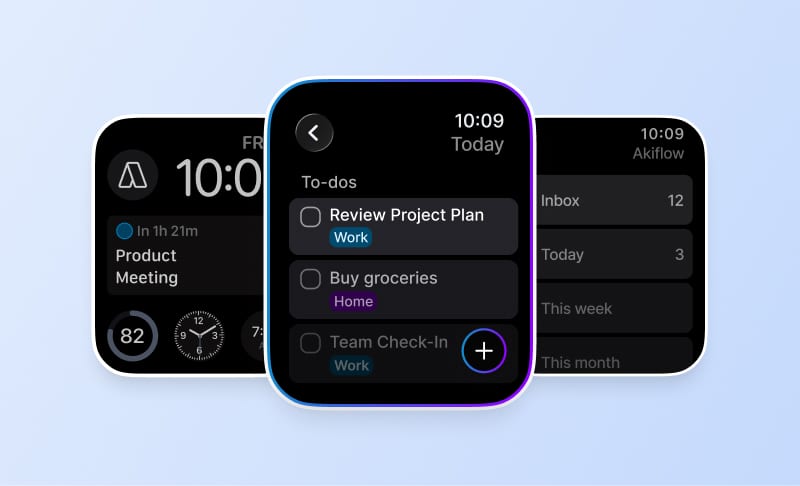
Apple Watch | Native capture and completion | No watchOS app listed |
iCloud Calendar | Direct connection | Direct connection |
Individual annual billing | US$19/month equivalent | US$15/month equivalent |
Two planners, not a planner versus a basic calendar
Morgen combines calendars and tasks and offers an AI Planner. It also documents integrations with task systems including Todoist, Notion, ClickUp and Linear. Describing it as a calendar with few integrations would hide precisely the features a prospective buyer needs to assess.
Akiflow’s emphasis is a personal inbox for actionable work and a fast route from capture to a time block. The practical comparison is how you gather commitments, review a suggested or manually arranged plan, and recover when the day changes. A long feature checklist is less useful than seeing those steps on your own workload.
When Morgen makes more sense
Morgen is worth testing when several calendar accounts are central to your work and you want planning assistance around them. Its AI Planner works with your tasks and planning preferences. Its desktop availability includes Linux as well as macOS and Windows, which can matter more than a small difference in individual features.
Imagine a researcher balancing teaching sessions, project work and personal appointments. If the task list is already organized, the main benefit may come from proposing a feasible arrangement around those appointments. Evaluate whether the suggestions respect the work periods you actually want, and how easy they are to review and change.
When Akiflow makes more sense
Akiflow is a good fit when the bottleneck comes before scheduling: requests are spread across messages and work systems, and you need to collect the actionable pieces. Its inbox and keyboard-oriented workflow help you make deliberate choices about what deserves time today.
For someone frequently away from the desk, the Watch companion adds a concrete capture path. A new commitment can be recorded from the wrist and dealt with later in the main planner. That is a useful difference from relying only on a phone, but it is not a substitute for reviewing and planning the task.
Do not confuse iCloud parity with Watch parity
Morgen documents an iCloud Calendar connection, so this is not an exclusive Akiflow feature. Test event permissions, recurring appointments and changes from another device in whichever product you choose. A shared read-only calendar will not become editable just because it appears in a planner.
Akiflow documents a native Watch app. Morgen’s App Store compatibility information reviewed for this update does not list watchOS. That is a narrower and more defensible statement than promising Morgen will never support it. Phone notifications appearing on a Watch are also different from a dedicated task app.
Pricing and a useful trial
At this review, Morgen advertises its individual plan at US$30 monthly or US$15 per month billed yearly, with a 14-day trial. Akiflow advertises US$34 monthly or US$19 per month billed yearly, with a seven-day trial. Compare current checkout terms, taxes and any applicable promotion before purchase.
Use a meeting-heavy day, not an empty calendar. Bring in two tasks from the systems you already use, reserve a long work session, then move one meeting. Judge the amount of intervention required to make the revised day believable. Include an iCloud event and, if relevant, a wrist-captured task. Choose the workflow you can maintain on a busy Tuesday, not the one that makes the most impressive first plan.
Akiflow Apple setup limits
Akiflow’s Watch companion supports capture, completion and current/up-next information, not task editing or rescheduling. It requires watchOS 10+ and a paired iPhone running Akiflow 2.83+. Its iCloud connection handles events, not Apple Reminders. Lock a task or Time Slot to publish it to an editable calendar; merely scheduling it does not export it. Sync is periodic, and calendar permissions still apply.
Setup and limitations: Akiflow Apple Watch guide; Akiflow iCloud Calendar guide.
Official sources
Frequently Asked Questions
How should I compare Morgen’s AI Planner with Akiflow’s workflow?
Start with the part of planning that takes effort. Morgen offers AI-assisted planning around tasks and calendar commitments. Akiflow emphasizes collecting actionable work and moving it into time blocks. Compare how you gather commitments, review the proposed or manually arranged day, and adjust it after a change, rather than treating AI as an automatic deciding factor.
When is task intake more important than arranging the calendar?
Task intake matters when requests are scattered across messages and work systems before you even begin scheduling. In that situation, evaluate how easily Akiflow’s inbox helps you collect actionable items and decide what deserves time. If the task list is already organized, arranging it around appointments may be the more useful comparison.
What should I check when using iCloud with either planner?
Both document an iCloud connection, so simply seeing an event is not a sufficient test. Check recurring appointments, permissions and changes made from another device. A shared read-only calendar does not become editable inside a planner. Judge whether the actions you need work with your actual calendar accounts.
How can a researcher evaluate Morgen’s planning suggestions?
Use a day containing teaching sessions, project work and personal appointments. With an organized task list, examine whether the suggested arrangement respects the work periods you actually want. Then review and change the proposal. The useful outcome is a feasible arrangement around those commitments, not just an impressive-looking initial schedule.
What is a realistic trial for choosing between the two?
Bring two tasks from your existing systems into a meeting-heavy day and reserve a long work session. Move one meeting, then assess the intervention needed to make the revised schedule realistic. Include an iCloud event if you use one. Choose based on a workflow you can maintain during a busy week.